Few terms in online marketing get used as often and defined as rarely as SEO optimization. Sometimes it means setting a title tag. Sometimes a six-month content strategy. Sometimes the configuration of a WordPress plugin. If you own a website and run into the topic for the first time, ten sources will give you twelve definitions. This post cleans up. It describes what SEO optimization actually covers, which five pillars the work falls into, which sequence works in practice, and which levers carry the most weight on small, mid-size and large sites.
What SEO optimization actually means
SEO optimization means shaping a website so it gets found better for relevant searches on Google (and other search engines). That sounds trivial, but it isn't. Behind "found better" sit three very different effects. The page has to enter the index at all. It has to surface for the right query. And it has to land at a position where a click is plausible. Anyone who works on only one of the three is optimizing a third. Anyone who works on all three systematically is optimizing the whole funnel.
A key distinction: SEO optimization is not a one-time action. It's a recurring process. Google updates its algorithm several hundred times per year. Competitors change their pages. Your own site grows, shrinks, switches CMS, changes host. Each of those shifts can cost visibility. If you treat SEO as a project with a start and end date, you've misunderstood it. SEO is a loop that turns every few weeks or months.
The other common confusion: SEO optimization is not the same as SEO analysis or audit. An analysis shows what's broken. Optimization is the actual work that follows. Tools give you lists. You change code, copy, images and configurations. Without execution, the best analysis is a PDF in the inbox.
The five pillars, in the right order
In trainings, workshops and client work, one split into five pillars has held up for me. They follow a logical order. Working on pillar four before pillar one means building on soft ground.
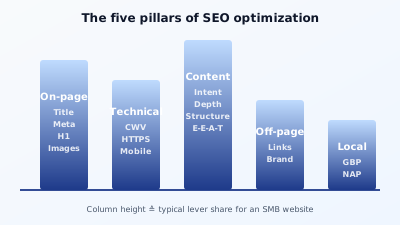
Pillar 1: On-page optimization. These are the levers on a single page. Title tag, meta description, H1, heading hierarchy, internal links, image alt text. It's the pillar with the fastest payoff. Changing a page's title and description takes five minutes and can halve or double click-through. If you don't clean up here, you lose clicks even at good positions. If nothing else happens, this is the first pillar you go through systematically.
Pillar 2: Technical SEO. This is the infrastructure. HTTPS, mobile friendliness, page speed, proper HTML structure, robots.txt, XML sitemap, canonical tags, structured data. Technical issues are often invisible to visitors but toxic for Google. A page that redirects three times before it loads, that blocks every second sub-page with noindex, that doesn't scale on phones, can have the best content in the world. The crawler still doesn't get through.
Pillar 3: Content. This is where it gets exhausting. Content optimization means your texts actually answer the question a searcher is asking. That's research work, not writing craft. You need to understand what sits behind a query, which information is expected, in what depth and form. A 300-word page on "create payroll" won't beat a 3,000-word guide with examples and a PDF template. This is where the biggest untapped lever lives for many sites.
Pillar 4: Off-page optimization. Backlinks from other sites, brand mentions, citations in directories, activity in your own industry. Off-page is the slowest pillar because it doesn't sit entirely in your hands. You can't buy a backlink that won't hurt you. But you can produce content others want to link voluntarily, and tend relationships that trigger mentions. Anyone who hasn't pillar one to three under control shouldn't worry about pillar four yet.
Pillar 5: Local SEO. For anyone with a physical location or a regional service area. Google Business Profile, NAP consistency, local reviews, LocalBusiness schema, location pages. If you run a café, a practice, a trade business or a law firm, this pillar often gets pushed to the back, and you miss that for local searches 60 to 80 percent of traffic flows through the Map Pack, not the organic positions.
These five pillars are not equally important. For a regional trade business with five pages, pillar five often matters more than pillar three. For a blog with 200 articles, everything revolves around pillar three and pillar five is almost irrelevant. The art of SEO optimization is recognizing your own ratio, instead of giving every pillar the same attention. For anyone curious how a concrete SEO suite from Germany brings these five pillars under one interface, the overview lives on the home page.
The SEO optimization loop in four phases
Before we dive deeper into the pillars, a meta layer. How do you structure the work so it doesn't tip into either hyperactivity or paralysis? Four phases that repeat, instead of a waterfall project.
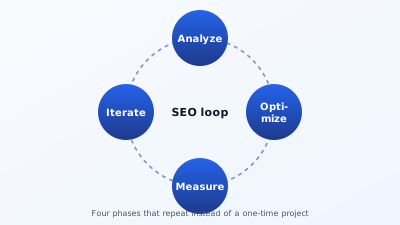
Analyze. You capture the status quo. Which pages exist, which rank for what, what does Search Console show, which technical problems are visible? Duration: two to four hours once for a 30-page site, then 30 minutes every few weeks for the update view.
Optimize. You work the findings off the list. Not all at once, in priority order. Two or three problems per week is enough if you stay disciplined. Anyone tackling 80 findings at once finishes 80 half-done edits.
Measure. You watch what your changes did. Position for your main keywords, clicks and impressions in Search Console, organic traffic in analytics, new backlinks. Important: SEO effects need weeks, often months. Whoever checks the result on day three after a title swap sees nothing and gives up.
Iterate. You take the measurement data and go back to analyze. What worked? What didn't? What was a coincidence? The answers shape the list for the next round.
A realistic rhythm is one full loop every four to six weeks. More doesn't make sense for small sites because the data gets too noisy. Less leaves too much on the table.
On-page optimization: the per-page levers
The on-page pillar is the one most should start with because it pays off fastest. Concretely: about eleven fields per page, of which few sites have all clean.
Title tag and meta description are the two most important because they appear directly in search results. A good title runs 30 to 65 characters, has the main keyword at the start, makes clear what's on the page. A good description has 50 to 160 characters and describes the benefit, not the function. "Serving you since 1987" is not a benefit. "Create payroll in under ten minutes" is. Treating title tag and meta description optimization as a side detail means missing the biggest free lever.
The H1 is the visible main heading on the page. It should appear exactly once and match the title thematically. Common mistake: logo gets marked as H1, then every sub-page has the same H1. Or a theme renders multiple H1 because the developer didn't grasp structure. Both are visible in source code and checkable in ten minutes.
The heading hierarchy (H2, H3, H4) should follow the structure. No jumps from H1 to H4, no five H2 without content between them. Search engines read the hierarchy as a table of contents, badly structured headings mean weak understanding.
Images need alt text. Not directly for SEO, but for accessibility, and Google honors both. Alt text is a brief description of what the image shows, not keyword spam. "Woman laughs in office" works. "Happy-secretary-payroll-Munich-2026" hurts.
Internal linking per page: every page should carry two to five internal links to other relevant pages. That helps visitors and search engines understand your site's architecture. Rule of thumb: important pages get many incoming internal links, unimportant pages few.
Technical SEO: the infrastructure nothing works without
The technical pillar intimidates many because it looks like HTML, server config and developer knowledge. In practice, most points are solvable with a good tool and a few hours of focus.
HTTPS hasn't been optional for years. Anyone running a 2026 site without an SSL certificate gets flagged "not secure" by the browser and loses both trust and ranking. Let's Encrypt provides free certificates, every serious host integrates them with one click.
Mobile friendliness is the standard since the mobile-first index. Google has assessed the mobile version of your site as primary since 2019. If you run an old theme that doesn't scale on phones, you risk not just positions but, in extreme cases, indexing itself. Google's mobile-friendly test is free and answers in 30 seconds.
Page speed is a ranking factor and a conversion factor at the same time. Google measures the Core Web Vitals, three metrics for the perception of load and interactivity: LCP (how fast the largest visible element appears), INP (how responsive the page is to input), CLS (how stable the layout is). If you're red here, you bleed systematically.
Robots.txt and XML sitemap are the two files that tell Google: what may be indexed, where you can find everything. The robots.txt is a simple text file in the root directory that works with User-agent and Disallow. The XML sitemap lists every indexable URL. Both files can be submitted in Search Console and should be consistent.
Canonical tags solve the duplicate content problem when the same content is reachable under multiple URLs. The canonical points to the "original" URL and tells Google: index this, ignore the duplicates. Main mistake: the canonical points to the home page or an old URL, or is missing entirely on filter and category pages in shops.
Structured data (Schema.org as JSON-LD) helps Google place the content of your page. A product page with Product schema can show prices and review stars in search results. An article with Article schema gets a better preview. A LocalBusiness schema ties your page to your Google Business Profile. Schema isn't mandatory, but it's a frequently underrated lever.
Try it yourself: The free SEO check at yourseo.app/analyse inspects any URL in under 30 seconds against all the technical and on-page fields mentioned in this post. No signup, no plugin, with concrete hints instead of score numbers.
Content optimization: the pillar with the biggest lever
If on-page and technical are the stage, content is the play that runs on it. A technically perfect page with thin content doesn't rank. A content-rich page on shaky technology ranks noticeably better than the other way around. On most sites I see, the biggest untapped lever sits in this pillar.
Content optimization starts with research, not writing. You need to understand what your audience searches for, in which phrasings, with which expectation. Tools give you search volume per keyword, but volume alone is treacherous. "Create payroll" gets 5,400 searches a month, but who is searching that? A bookkeeper looking for a job? A managing director without an accountant? A mother with a mini-job question? Each of these people has a different search intent.
Search intent is the central question. Google roughly distinguishes four intent classes: informational (someone wants to learn), navigational (someone is looking for a known brand), transactional (someone wants to buy), and commercial investigation (someone is comparing before buying). A page that serves the wrong intent doesn't rank. Putting a product page against an information search means fighting Google, not working with it.
The next question is depth. How thoroughly does your page cover the topic compared to the ones already ranking? A multi-year Backlinko study showed top-10 results for many B2B topics average 1,400 to 2,500 words. That doesn't mean every post needs 2,500 words. It means a 300-word page rarely beats a 2,000-word guide. What counts is the right word count per page, not a generic minimum.
Structure beats length. A 4,000-word post without headings, without lists, without examples doesn't get read. A 1,200-word page with clear structure, concrete examples, a comparison table, an FAQ at the end is often the better choice. Write for people who scan, not those who read linearly. Headings, bullets, emphasis, mini-summaries at the start of long sections, all serve fast comprehension.
E-E-A-T (Experience, Expertise, Authoritativeness, Trustworthiness) is Google's guideline for quality. It's not a direct ranking factor, but it sits in the Quality Rater Guidelines and therefore indirectly in every algorithm update. Practically: author boxes with real names and qualifications, last-updated dates, source citations, sober tone, clear distance from sales speak.
Off-page optimization: why others have to talk about you
Off-page is the pillar you don't fully steer alone. It covers everything that happens away from your site and sends Google a signal about you: backlinks, brand mentions, citations in industry directories, activity in forums and social.
Backlinks have been a core ranking signal since the early years of the web. Google reads any link from site A to site B as "A endorses B". The more, and the higher quality, the endorsing sites, the higher your domain's authority climbs. That's the theory. In practice, link building is the most laborious and most-cheated SEO discipline. Buy links and you risk penalties. Order cheap from backlink providers and you get spam profiles. Have no strategy and you stay visible where you already are.
What works: content others want to link voluntarily. An original study with real data. A free tool for an industry problem. An honest guide nobody else has written that deeply. Anyone who produces three of those a year builds a natural link profile over years. Anyone who writes fifty interchangeable blog posts doesn't get linked.
Brand mentions are the younger sibling of backlinks. When your brand name appears on serious sites without a link, Google still registers it. Anyone who builds a name in the market gains a form of authority that's independent of classic link building. That's slow work, often a matter of years, not months.
Local SEO: the fifth pillar many touch too late
If you have a physical location or serve a regional area, you can't avoid local SEO. The Google Business Profile (formerly Google My Business) is the central element: a verified entry with address, phone, hours, categories, photos, posts and reviews. If you're not active here, you surface worse in local search, regardless of website quality.
NAP consistency stands for Name, Address, Phone. These three details must be identical across all directories: on your own site, in the Google Business Profile, in industry directories, in OpenStreetMap, in local portals. Even small differences ("Street" vs. "St.", "GmbH" vs. "GmbH & Co. KG") confuse the algorithms.
Local reviews are their own universe. A practice with 4.7 stars and 280 reviews appears in the Map Pack more visibly than one with 4.9 stars and 12 reviews, because count, recency and consistency factor in. It pays to actively prompt reviews, for example right after an appointment by email or via QR code at reception. Important: no fake reviews, no paying, no filters ("only ask 5-star customers"). All against Google's guidelines, and regularly caught.
What doesn't belong to SEO optimization, even though it gets bundled in
Worth listing a few things that often run under the SEO label but, strictly, are something else. That makes your own budget item clearer.
Paid ads (SEA, Google Ads) are not SEO optimization. Both sit under search engine marketing (SEM), but ads work with other levers, other tools, a different skill set.
Pure content production without an SEO brief isn't SEO either. Anyone who "commissions an article" while the writer skips keyword research, competitor analysis and a structure brief rarely ranks. Content is mandatory in SEO, but content alone isn't enough.
Social media management is not SEO. Social signals have been confirmed as non-direct ranking factors for years. Indirectly, reach can lead to backlinks and brand mentions, but that's a detour.
Conversion optimization is not SEO. It's the question of what happens after a visitor lands on your page. The two disciplines complement each other but stand alone. If you have 10,000 organic visitors and 0.5 percent convert, you have a conversion problem, not an SEO problem.
An honest sequence for the first twelve weeks
If you're starting SEO optimization today, the question is: where do I begin? A sequence that works in practice:
Weeks 1-2: Capture the status quo. A full SEO audit of your own domain, connect Search Console, define the ten most important keywords, build a list of the twenty most important pages. No optimization, only diagnostics.
Weeks 3-5: Walk through the on-page pillar. For each of the twenty most important pages, rewrite title and description, check H1, order the heading hierarchy, add alt text, set internal links. That's hand work, but it moves the needle fast.
Weeks 6-8: Clean up the technical pillar. Measure Core Web Vitals and identify the biggest brakes, ensure HTTPS, check robots.txt and sitemap, hunt broken links, add structured data for the most important page types.
Weeks 9-12: Tackle the content pillar. Expand the five pages with the biggest potential (good position, weak content). Better five pages done well than twenty half done. In parallel, produce the first new piece that's actually link-worthy.
After that, the loop repeats every four weeks with shifting focus. Local and off-page enter the picture depending on business model, on a delayed schedule.
How to tell if it's working
Three metrics are enough at the start. Visibility, clicks, conversions.
Visibility measures how high your domain ranks for a defined set of keywords. Tools give you an aggregated number for that, usually called a visibility index. Important: compare yourself with yourself over time, not against competitors in absolute numbers. Every tool measures differently.
Clicks from Search Console show what actually arrives. If clicks rise without impressions rising, you've worked on titles and descriptions. If clicks and impressions rise together, you're building visibility. If both stagnate, optimization is idling.
Conversions are the honest end measure. SEO is not an end in itself, it's an acquisition channel. If clicks climb but inquiries or sales don't, you've either served the wrong intent or the page doesn't convert. In both cases, look at the landing page experience, not the ranking.
At a glance
SEO optimization is the recurring work of making a website more findable on search engines. It has five pillars (on-page, technical, content, off-page, local), runs in four phases (analyze, optimize, measure, iterate), and takes weeks to months before it becomes measurable. Whoever cleans up on-page and technical before content and off-page is building on solid ground. Whoever pushes the loop with discipline builds an acquisition channel that doesn't bill them daily through an ad platform. The first twelve weeks decide whether routine sets in, or just a vague hope that "SEO" will work out one day.