"What's my visibility on Google?" Almost everyone who runs a website asks this at some point. The answer feels like it should be a single number, preferably green, ideally trending up. Behind that wish sits a term that SEO tools cannot even agree on. If you want a real grip on what your site is doing in search, you need a clear picture of what visibility is. And, just as important, what it is not.
Visibility is not traffic
The most common mistake: treating visibility as a synonym for visitor counts. It is not. Visibility describes how present your site is in Google's results for the queries that matter. Whether anyone actually clicks is a different question entirely.
A page can sit at position 1 for a keyword nobody searches. Top spot, perfect technical visibility, zero traffic. The opposite is just as true. A page at position 8 for a high-volume query will pull more visitors than the position 1 page above it. So visibility is a potential metric. It tells you how seriously Google treats your page as a candidate answer, not how many people reward you for it.
This is exactly why visibility is a more stable long-term indicator than traffic. Traffic swings with season, holidays, algorithm updates and trends. Visibility reacts slowly. It shows how your structural position inside Google's organic results is shifting over time.
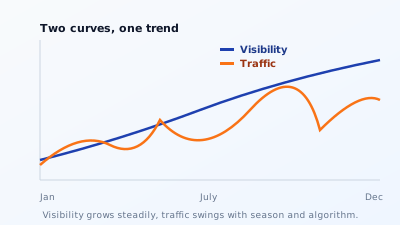
How a visibility index works
The best-known indicator is the visibility index. The format that everyone uses today was popularised by the German SEO tool Sistrix. Almost every competitor has now built its own version.
Simplified, it works like this. The tool defines a keyword set, often somewhere between a hundred thousand and a few million keywords per country. It checks regularly which position your domain holds for each of those keywords, then weights the positions by search volume and rank. A page ranking in position 1 for a high-frequency keyword contributes far more to the index than one sitting at position 50 for a niche term.
The result is a single number you can watch over time:
- Rising, you are gaining structural ground in Google's results.
- Falling, you are losing position. Or competitors are gaining faster than you.
- Flat, you are holding your level.
One thing worth remembering: a tool's visibility index is never an official Google metric. It is a model that only sees the keywords the tool tracks. A site that specialises in deeply niche queries can look invisible in one tool and prominent in another, depending on which keyword set is used.
Three terms people keep mixing up
So you can hold your own in any conversation, here are the three big ones cleanly separated:
| Term | What it measures | Source |
|---|---|---|
| Visibility index | Structural presence across a defined keyword set | SEO tools (Sistrix, Ahrefs, yourseo, ...) |
| Impressions | How often your page was actually shown in a result list | Google Search Console |
| Organic reach | Unique users who saw or visited your site | Analytics tools |
The visibility index is a model metric that tools calculate. Impressions are the reality from Google: how often your page actually appeared in a search. The two correlate, but they are not identical. If your visibility index climbs hard and your impressions stay flat, chances are you rank for keywords nobody searches, or your tool's keyword set just doesn't cover your market well.
What actually moves visibility
The list of factors is long, but it boils down to a handful of levers:
- On-page basics: title tags, meta descriptions, clean HTML, sensible headings, a clear URL structure. The foundation. Fail here and not much else helps.
- Content quality and depth: Google has spent years weighting how thorough and trustworthy content is. Thin 200-word posts barely rank anywhere now.
- Technical performance: load times, mobile rendering, Core Web Vitals. A site that takes eight seconds to respond drops out of the top spots quickly.
- Backlinks: other sites pointing at you still signal to Google that you are a serious source. Less decisive than a decade ago, but still relevant, especially in competitive markets.
- Trust signals: HTTPS, a real legal page, reviews, a privacy policy. Google increasingly judges whether a site feels trustworthy. Especially for YMYL topics (Your Money, Your Life: health, finance, legal).
What no longer works: keyword stuffing, thousands of identical backlinks, hidden text, bought reviews. Google has gotten good at catching this. If you want a non-marketing overview of how search engine optimisation evolved as a discipline, Wikipedia has a solid summary.
Industry benchmarks: what's realistic?
The most common question in a first consultation: "My visibility index is at 0.12. Is that good or bad?" The answer depends on your market. An index value is only meaningful relative to your peers.
Rules of thumb that hold in the DACH region:
- Local service providers with under 20 pages. Realistic values sit between 0.01 and 0.3. Hitting 0.5 usually means you've become regionally well-known.
- B2B consultancies and niche specialists. Rarely above 1.0, because per-keyword search volume is small. What matters more than the absolute number is visibility for the ten to twenty queries that actually drive purchasing.
- Online shops with 200 to 2,000 products. Values run from 1 to 50, depending on how competitive the main categories are.
- Large publishers and brand domains. From 100 upward, in the top tier above 1,000. Out of reach for SMBs and not a meaningful comparison target.
What you should really measure: your own change over time. Plus 30 percent over six months is an excellent result, completely independent of the starting value. Minus 20 percent over three months is a warning sign you should investigate immediately.
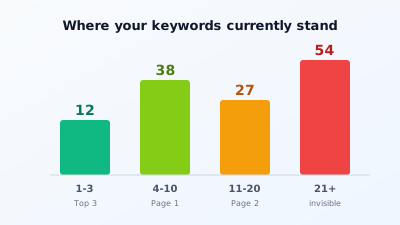
A more useful lens than the aggregate index: split your keywords by position bucket. How many sit in the top 3, how many on page 1, how many on page 2 or worse. That distribution tells you more about what you can move than any single index number.
Check your own baseline: The free SEO check at yourseo.app/analyse shows you in under 30 seconds where the on-page basics of your most important page stand. That's the foundation visibility eventually has to rest on.
How to watch your visibility
Three approaches that complement each other.
Google Search Console is the official source. It shows you impressions, clicks, CTR and average position for your domain, per query, per URL, per device, per country. Free, from Google directly. The downside: you only see data for your own site. No competitor comparison, no forward-looking estimates.
An SEO tool with a visibility index: Sistrix, Ahrefs, Semrush, or yourseo. These tools track your position for thousands of keywords across your market and give you the index as a time series. One caveat: do not compare absolute values across tools. The Sistrix index is not the Semrush index.
Manual spot-checks. Search your most important keywords directly on Google now and then, ideally in an incognito window with a fresh cache. That gives you the unfiltered picture, without your own search history skewing the result.
A practical routine: list the 10 to 20 keywords that actually matter to your business. Check the position monthly. Compare it with your tool's visibility index. If they move together, you have a reliable read. If they diverge, find out why. Usually it is either a new competitor or a shift in search volume.
The most common misinterpretations
Three mental traps come up in consultations again and again.
"My index dropped 5 percent, so I must have done something wrong." Not necessarily. When Google re-estimates search volume for a few hundred of your keywords, the weighting inside the index model shifts automatically. You changed nothing, the value sinks anyway. Without looking at individual keywords, that statement is worthless.
"My index is rising, so SEO is working." Also not automatic. If your tool suddenly adds 5,000 new keywords to its set because they developed search volume, your index can rise even though your actual rankings haven't changed. Tool updates to the keyword universe move the index without your SEO getting any better.
"Visibility has to grow linearly, otherwise something's wrong." Realistically, growth looks like stairs with plateaus. Three to six months of flat motion are normal, especially when you're building new content that hasn't ranked yet. Patience here is a skill, not a weakness.
A 90-day setup for watching it
You don't need a twelve-month strategy to take visibility seriously. Three months are enough to build a defensible baseline and draw the first real conclusions.
Week 1. Set up Search Console if you haven't yet. Verify ownership, submit a sitemap, grant access to whoever needs it. Compile a list of 15 core keywords that genuinely drive sales for your business. Not generic categories like "consulting" or "software", but long-tail terms with intent behind them.
Weeks 2 to 4. For each keyword, note the current position. Where possible, also record the visibility index value from your tool. Identify three direct competitors and capture their positions for the same keywords. That is your baseline. Without a baseline, every later change is speculation.
Month 2. Fifteen minutes a week in the Search Console. What are the top queries, what are the top pages? Do they line up with your 15 keywords, or are you ranking for things you didn't even have on your radar? The second case is common and points to unused content.
Month 3. First assessment. Compare positions to baseline. Compare with competitors. Compare the index trend if you use a tool. Three questions to close: which keywords improved, which got worse, and which surprising new terms surfaced? From those answers the next three months of optimisation focus emerges.
Anyone who sets this up cleanly once and then invests twenty minutes a month has, within a year, a clearer picture of their own visibility than many agencies have of their clients.
Quick FAQ
How fast do SEO measures show up in the index? On-page changes typically after four to eight weeks. Backlink building or new content that needs to rank, more like three to six months. If you want faster measurable effects, optimise CTR through title and description, that works within days.
Do I even need a paid tool for this? For a small site, Search Console plus your own spreadsheet with ten to 20 keywords is enough. For multiple domains, competitor comparison or trend visualisation, a tool starts to pay off the moment your spreadsheet has three tabs.
What do I do if the index suddenly drops 30 percent? First open Search Console and check whether impressions also dropped. If yes: technical issue (indexing blocked, robots.txt wrong, server error). If no: probably a core update or a tool-internal setup issue. Google Search Central publishes official commentary on every major update.
Is the visibility index enough as a sole KPI? No. It's a trend, not an outcome. What ultimately counts are clicks and conversions. Visibility without clicks is pointless, clicks without conversions just as much. The three only make sense read together.
Is visibility tracking worth it for very small sites? Yes, but lightly. If you have five subpages and 30 daily visitors, you don't need a tool. A monthly incognito spot-check of three keywords is enough. As soon as you publish regularly and traffic crosses 500 a month, systematic tracking pays off.
Does checking my own visibility affect my Google ranking? No. Looking at your position in an incognito window or via a tool changes nothing. What Google does notice: when you search for yourself on Google and click your own listing. That distorts CTR statistics. So for your own checks always use incognito or go straight to Search Console.
What to take away
Visibility is a trend metric, not a daily number. Don't stare at the index every morning. Swings of a few percent are normal noise and tell you nothing about your SEO performance. The change over weeks and months is what matters.
Three points worth keeping in mind:
- Visibility is not traffic. Visibility is the potential, traffic is the realisation. They belong together, but they aren't the same thing.
- Every tool has its own index. Don't compare values across tools, watch the trend within a single tool.
- Search Console is the truth about your own site. Tools estimate, Search Console measures. Reading both together gives you the full picture.
Once you have that mental model, you are past the first big hurdle in evaluating your own site. The next step is understanding what concretely moves that visibility. That is where the next posts pick up.