Doing your own SEO sounds like weekend tinkering, but it isn't. It's a clearly structured craft, doable in three to five hours per week alongside a full-time job, if you have a sequence and stick to it. This post delivers exactly that: an 8-week plan with weekly tasks, an honest time budget, a statement of what's in scope at the end, and an honest point where DIY hits its ceiling. Written for self-employed people, small businesses and marketing leads with no prior SEO experience.
Who can do their own SEO, and who can't
Worth being honest at the start. Not everyone can or wants to do their own SEO, and there's no moral merit in it. Three conditions should come together for the DIY path to make sense:
One, you can change text and tags on your site. More trivial than it sounds, but on many small sites the CMS password is lost, the theme is old and hard to use, or the site was built externally without a handover. Anyone who can't edit their own site can't do their own SEO. The first task then is to get access, not to book an SEO tool.
Two, you have three to five hours per week free. Sounds like little, but it's mandatory. Whoever finds only an hour every two weeks in the first eight weeks won't make the plan. Better to ask an agency directly or wait until time is there.
Three, you're prepared to wait six to nine months for visible results. SEO is slower than Google Ads. Anyone expecting revenue to double in four weeks will be disappointed. Whoever accepts that the first effects become measurable from week eight and tangible from month six can stay the course.
If all three apply: the DIY path is not just possible, it's often better than a cheap agency. You build domain knowledge about your own site that nobody else has. You save between €1,000 and €8,000 per month. And you keep control over what actually happens.
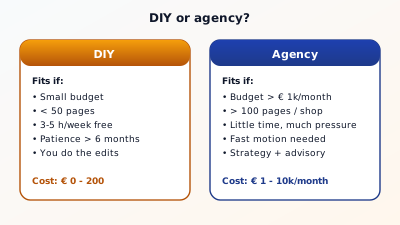
If one of the three is missing, the answer is clear: agency or freelance SEO. Anyone trying to do their own SEO with 100 pages and a full-time job will give up frustrated in four months.
What the 8-week plan realistically delivers
Before diving in, a sober look at the outcome. After eight weeks of DIY SEO on a 20-to-40-page site you have:
- A cleanly configured Search Console with data on your actual queries
- Title and meta description reworked on every important page
- Heading hierarchy ordered on the most important pages
- All images with alt text, the most important compressed
- Internal linking set systematically
- robots.txt and sitemap checked and submitted in Search Console
- Structured data added for at least one page type
- Google Business Profile complete (if you have a location)
- Three to five content-weak pages expanded
What you won't have after eight weeks: a full backlink strategy, a competitor analysis report on twelve rivals, a complete content plan for the next twelve months, deep technical audits on JavaScript rendering. That's the ceiling. None of that fits into eight weeks DIY without other work suffering.
The pillar post on SEO optimization holds the five pillars in detail. The 8-week plan covers on-page and technical entirely, a large part of content, and local as far as relevant. Anyone wanting to flank the DIY path with a German SEO tool finds the feature overview on the home page. Off-page (backlinks) and deeper content strategy are areas to continue past week eight.
The time budget per week
So you can plan: here's the honest time budget per phase. The totals fit a 20-to-40-page site. With more pages, week 2-3 (title and meta work) primarily scales up.
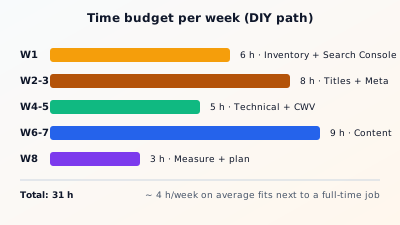
About 31 hours total across eight weeks. Whoever wants to do this in five 6-hour sessions has it faster. Whoever splits it into two hours per week takes twelve instead of eight. Both work as long as you stick with the plan.
Week 1: Inventory and Search Console
The most important week because it builds the data base. Without it, you walk in the dark.
Day 1-2 (2 hours). Build a list of all URLs on your site. Source: your XML sitemap (often at your-domain.com/sitemap.xml), your CMS backend, or a simple browser plugin that extracts links from a page. Three columns per URL: URL, page type (home, service, blog, location, other), importance (High/Medium/Low).
Day 3-4 (2 hours). Set up Google Search Console. Add property (domain or URL prefix), confirm ownership via DNS record or HTML file, submit sitemap. Then wait 24 hours and look at first data: which pages does Google know, which queries bring impressions, which clicks.
Day 5-6 (2 hours). Bing Webmaster Tools alongside (same procedure, often imports from Search Console). Measure PageSpeed Insights for the three most important pages. Note results as baseline. If load time is over 4 seconds, week 4-5 arrives with a clear need.
Week 2-3: Titles and meta descriptions
The weeks with the biggest short-term lever. You invest 8 hours that typically bring 20 to 40 percent more clicks in four to six weeks, without positions having to change.
Concrete task. Write a new title and a new description for the 20 to 30 most important pages from your inventory. Three to five minutes of writing per page, five minutes of CMS entry, so eight to ten minutes total. At 25 pages we land at four to five hours of work.
Title rules. 30 to 65 characters, main keyword as far forward as possible, unique per page, brand name at the end with separator (| or ·). Example: "Create payroll in 10 minutes | Müller Firm".
Description rules. 50 to 160 characters, benefit instead of function, unique per page, ideally with a call to action at the end. Example: "Payroll for 1 to 50 employees from €9 per employee. Appointments in 24 h. Ask non-binding now."
After you've got the system on the first five pages, the remaining 20 run quickly. More details and examples in the post on title tag and meta description optimization.
Week 4-5: Technical and Core Web Vitals
This is more technical, but not so technical that you need a developer. Most steps are configuration or CMS plugins.
Check HTTPS. A padlock icon should appear in the browser, not "not secure". If not: activate Let's Encrypt through your host, takes 15 minutes.
Run the mobile test. Per important page, run Google's Mobile-Friendly Test. Issues are usually fixable in the theme (font too small, click elements too close together, horizontal scroll).
Optimize Core Web Vitals. PageSpeed Insights gives concrete suggestions per URL. The most common DIY fixes: compress oversized images (TinyPNG, Squoosh), deactivate unneeded plugins, enable lazy loading (built in to WordPress). More in the post on improving Core Web Vitals.
robots.txt and sitemap. Visit robots.txt at your-domain.com/robots.txt. Should at minimum contain a Sitemap: reference and no accidental Disallow: / (that blocks the whole site). Submit sitemap in Search Console.
Add structured data. For home page (Organization or LocalBusiness) and one other page type (Article for blog, Service for service pages). Copy code snippet from Schema.org generators, paste into the page's HTML <head>, check with the Google Rich Results Test.
Try it yourself: The free SEO check at yourseo.app/analyse inspects a URL against all on-page and technical fields. Ideal for week 1 (baseline) and week 8 (success check), because the same methodology before and after the plan delivers comparable data.
Week 6-7: Build content depth
The exhausting weeks. Writing can't be sped up, and it's easier to push through after first wins because you have evidence the work pays off.
Task. Identify three to five content-weak pages from your inventory and expand them. Weak means: under 500 words, but with potential per Search Console (sitting at position 11 to 30 for a relevant keyword).
Approach per page. Define main keyword. Look at the first ten Google results for this keyword. Which sections or questions are covered that your page doesn't have? What depth do the competitors have? Which tables, lists, examples? You add what's missing without copying competition. Goal: 1,000 to 1,500 words with your own angle, at least one concrete example, at least one table or list.
About 2 hours per page. One hour research and structuring, one hour writing and CMS maintenance. At three pages we land at six hours, at five at ten. This is the biggest single lever in the whole plan.
Week 8: Measure and plan the next loop
The reward week, when you see the first effects and design the next plan.
Look in Search Console. Compare clicks and impressions of the last four weeks against the four weeks before. Which pages have more clicks at the same position? Which have gained positions? Which new queries have appeared?
First corrections. Adjust title or description if a page has good impressions but weak click-through. Set an internal link if a page could rank but receives no internal links.
Plan for the next four weeks. What worked, what didn't? Which two or three clusters do you tackle next? Which content page do you expand next time?
That closes the first loop. From here the same mechanism runs every four weeks with less effort because the base is in place.
Three common traps in DIY SEO
Anyone doing their own SEO typically runs into three traps, all avoidable when you know them.
Trap 1: Tool hopping. Every third blog mentions a new tool that solves everything. Tools are multipliers, not solutions. If you don't have a title strategy, the best title optimization tool won't help. Stay on free tools for the first eight weeks (Search Console, PageSpeed, Mobile Test, a single on-page checker). You don't need more.
Trap 2: Long content without substance. The rule of thumb "at least 1,500 words per post" circulates. The truth: long content ranks better when it has substance. A 1,500-word post with fluff and repetition is worse than 600 words of substance. Anyone using AI tools for text runs directly into this trap.
Trap 3: Backlink tricks. You'll find forum posts, guest article offers or "backlink packages for €99". Stay away in the first months. A single bad backlink in bulk directories hurts more than ten good on-page edits help. Off-page comes later, and differently.
When the DIY path hits its ceiling
Three signals tell you you've hit the DIY limit:
You've run the loop three times but movement is shrinking. The first two rounds typically show jumps in clicks and positions. From round three on it slows because the easy levers are spent. What's now missing is often backlinks, competitor analysis and deeper content strategy. A specialized agency or a freelance SEO expert providing point support helps here.
Your site grows past 100 pages and becomes too complex for the manual spreadsheet. At the latest now you need a professional audit tool that checks more than 100 URLs in one crawl and groups problems by cluster.
You recognize that a critical business decision depends on SEO. Example: you launch a new product in a dense competitive situation and need visibility within three months. DIY is too slow here. An experienced agency can make the time-to-result jump.
In all three cases DIY hasn't failed, it has built a base on which every further investment (tool or advisory) delivers far more impact. Anyone hiring an agency from day one often doesn't even know whether the work delivered is good. Anyone with two DIY loops behind them can cleanly assess any agency output.
An official, free companion to the plan is the SEO Starter Guide from Google. It deepens every step with examples and gets updated regularly.
What comes after week 8
After the first 8-week plan, three further stages open up, each typically taking four to eight weeks.
Stage 2: Local and reviews. Anyone with a location expands the Google Business Profile after the first loop, starts a review campaign, sets LocalBusiness schema for every location. Three to four weeks of work, often with great local impact. More in the post on Local SEO in 2026.
Stage 3: Content clusters. You build topic clusters of multiple linked posts around your two or three main keywords. Five to eight posts per cluster at 1,500 to 2,500 words, plus a hub page bundling everything. Effort: two to three months per cluster.
Stage 4: First backlink work. Now you can begin targeting mentions and links deliberately. Guest articles on suitable industry blogs, studies or tools that get linked naturally, collaborations with non-competing partners. This is the off-page pillar. It needs months, not weeks.
At a glance
Doing your own SEO is doable in eight weeks at 3 to 5 hours per week if you have access to your own site and patience for visible results. The plan fully covers on-page and technical, builds content depth on three to five pages, and creates the data base (Search Console) every later stage builds on. Cost: €0 to €200, effect: on-page pillar clean, first movement in clicks and positions. The ceiling sits at backlinks, competitor tracking and large sites. Anyone who runs two DIY loops can then assess any agency investment cleanly.