For a long time a simple equation held: rank one to three on Google and you are visible. That equation no longer holds reliably. Google answers more and more queries directly at the top in an AI answer, the so-called AI Overview. The user reads the answer and often does not even scroll down to the classic blue links. That has an uncomfortable consequence: you can sit at position three and still be invisible, because an AI answer above you fills half the screen. The decisive question is no longer only "what position am I," but "am I named as a source in the AI answer." That is the new currency, and it can be measured.
What is shifting right now
Generative Engine Optimization, or GEO for short, is the name for exactly this shift. It is no longer only about appearing near the top of a list of ten results, but about showing up in the summarised AI answer that Google places above that list.
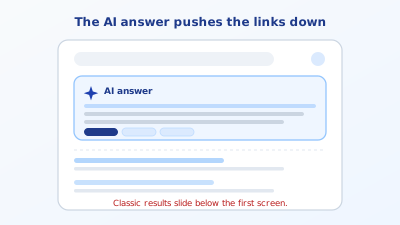
The effect is called zero-click. For many queries the user gets their answer directly in the AI box and clicks no result at all. For websites that live on clicks, that is noticeable. The clicks that remain are distributed differently: a large share goes to the sources linked in the AI answer. Whoever appears there as a source wins visibly, whoever does not loses quietly.
It is important to see this soberly. SEO is not dying, it is shifting. The foundations stay the same: good content, clean technology, trust. But a second layer is added, on which it is decided who is visible in the AI answer. Those who take this layer seriously early secure a head start in a field that is only just emerging. Which myths persist around AI and Google, and what is actually true, is taken apart in the post on Google AI SEO myths.
The new currency: being cited
Why is it so valuable to stand as a source in the AI answer? Three reasons.
First, visibility itself. The AI answer sits right at the top, above even the first classic result. A source mention there is more prominent than a good organic ranking, because it sits exactly where the user's eye lands first.
Second, the click-through rate. If your page is linked in the AI answer, the likelihood that someone clicks rises noticeably. The user has read the answer, wants to know more, and follows the source that the AI itself has marked as trustworthy.
Third, the quality of the clicks. Anyone who still clicks after reading the AI answer has genuine, deeper interest. These are not the fleeting visitors who are gone after three seconds, but people who want exactly your topic. Fewer clicks, but more qualified ones.
With that, the success metric shifts. The raw position remains a signal, but it now only tells half the story. The other half is the question of whether and how often you are cited. And that half has so far been a blind spot, because hardly anyone has measured it systematically.
An example makes it tangible. A DIY advice portal sat steadily at position two for an important tutorial. Yet clicks dropped by a third within a few months, without the position getting worse. The reason only showed on closer inspection: Google now displayed an AI answer for that query, and the portal was not linked in it as a source. The position was held, the visibility was gone anyway. Only after the key paragraphs were pulled up as short, clear answers right under their headings did the page appear as a cited source in the AI box a few weeks later, and the clicks recovered. Anyone who only looked at the position would never have understood the problem.
What you have to measure now
If you want to stay visible in the AI age, you need different numbers than just the classic position. Three metrics give the picture.
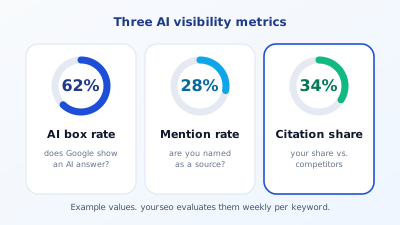
The AI box rate answers the first question: for how many of your keywords does Google show an AI answer at all? That reveals how AI-driven your topic field already is. In some industries an AI box appears almost always, in others hardly ever. This number decides how urgent the topic is for you.
The AI mention rate answers the second question: for how many of these AI answers is your own domain named as a source? That is your real presence in the AI world. A high AI box rate with a low mention rate means: the topic runs through AI, but without you.
The citation share answers the third question: what share of all cited sources do you hold compared to your competitors? That is your share of voice in the AI answers. It shows not only whether you appear, but how dominant you are compared to the competition.
These three numbers together do not replace the position, they complement it. Only both layers side by side, classic position and AI status, show the full picture of your visibility.
In practice the numbers tell a story in combination. High AI box rate, low mention rate: your market runs through AI but without you, this is where the pressure is greatest. Low AI box rate: your topic field is still classically shaped, you have time to prepare. High citation share: you are already a fixture in the AI world, now it is about defending. Only this reading turns three percentages into a concrete to-do list, instead of just another metric in the dashboard.
Try it yourself: The free SEO check at yourseo.app/analyse now includes a GEO readiness check. It checks in under 30 seconds whether your page has the structure an AI needs to cite it: schema depth, short citable answers, and fact anchors.
How to become citable
Measuring is half the battle. The other half is building your content so an AI draws on it as a source at all. The principle behind it is simple: an AI has to be able to take a clear, self-contained statement from your text without understanding the whole article. It works in chunks, looks for the matching paragraph, and passes it on. Four levers count especially.
Core answers right under the heading. An AI extracts content paragraph by paragraph. It looks for the passage that answers a question most clearly and cites it. If your main answer sits in two or three short sentences right under the matching heading, before you elaborate, you make it easy for the AI. Hide the answer in the fifth paragraph and you get cited less often.
Deepen schema markup. Structured data for organisation, author, FAQ, and product helps the AI place your content and recognise it as a reliable source. Schema is the machine-readable layer that tells the AI what a piece of content actually is. The deeper and cleaner it sits, the sooner you are understood.
Own data as fact anchors. Your own statistics, concrete numbers, and clear lists are cited preferentially. An AI looks for facts it can pass on, and likes to fall back on sources that deliver solid, unambiguous statements. Contribute your own data instead of repeating generalities, and you become the source.
Show real experience and authorship. Demonstrable experience, recognisable authorship, and depth are the foundation. These signals, often summed up under the abbreviation E-E-A-T, apply to classic SEO and AI visibility alike. The AI prefers sources with substance and identifiable people behind them. How AI search systems pick their sources in detail is explored in the post on optimising for AI search.
GEO does not mean forgetting SEO
A clear word is needed here, because there is a lot of panic around. The AI answer does not replace search, it complements it. Anyone who now throws all their classic SEO overboard to optimise only for AI is making a mistake. The truth is less spectacular: the foundations that make a page rank well are the same ones that make it citable. Deep content, clean technology, trust.
GEO is therefore not a new discipline that devalues everything before it, but an additional lens on the same work. You keep optimising for good placements, but additionally make sure your content also works in the summarised AI answer. How your overall visibility on Google develops remains the central question, only the answer now spans more than ten blue links.
The advantage for anyone acting now is the timing. The field is new, very few measure their AI visibility yet, and even fewer optimise for it deliberately. Those who start early build a head start that is hard to catch up on later, much like classic SEO fifteen years ago. Back then, the first to take search engines seriously secured positions that are hard to win today. In the AI answer this pattern is repeating right now, only faster.
How yourseo tracks this now
So you do not have to guess whether you appear in the AI world, yourseo now has the AI visibility module. It sits right inside your rank tracker, you do not have to learn anything new. Per keyword you now see, next to the classic position, the AI status: cited, not cited, or no AI answer. On top come the three metrics, AI box rate, mention rate, and citation share, across your entire keyword set.
The evaluation runs weekly, and that is on purpose. AI answers do not change hourly the way a classic position can fluctuate. A weekly cadence reflects the actual development cleanly, without misleading you through daily noise. In a first beta stage, AI brand tracking is added, checking whether your brand appears in the answers of common AI chats and in what context, so beyond Google's AI answer.
You will find all the details, the metrics at a glance, and the pricing on the page about AI visibility. The module is an add-on to the existing SEO subscription, the GEO readiness check in the free SEO check stays free for everyone. Google itself documents, by the way, how its AI features in search work and which content they draw on, a look there is worth it before you plan larger changes.
Quick FAQ
Does this mean my ranking no longer matters? No. The classic position remains an important signal and often the basis for appearing as a source in the AI answer at all. It just no longer tells the whole story. AI status and position complement each other. In practice the cited sources often come from the top organic results, so good rankings remain the entry ticket.
Do I have to rewrite my content completely? Usually not. Targeted tweaks are often enough: core answers right under the heading, deeper schema markup, your own fact anchors. The GEO readiness check shows you where the lever is biggest.
Why is AI visibility only measured weekly? Because AI answers do not change hourly. A weekly evaluation shows the real development and avoids false conclusions from short-term fluctuations.
Is this worth it even for small websites? Yes, especially then. Small providers can appear in the AI answer alongside big ones if their content answers the question most clearly. The AI judges the quality of the answer, not just the size of the brand. For smaller sites this is a real opportunity, because a precise, well-structured answer counts for more here than a large advertising budget.
Does this apply only to Google or to other AI systems too? The core revolves around Google's AI answer, because that is where most of the traffic comes from. The same principles, clear answers, clean schema, and solid facts, also help you appear as a source in other AI chats. The brand tracking in beta covers exactly this area in addition.
At a glance
A top ranking alone no longer guarantees visibility once the AI answer pushes the classic results down. The new currency is the citation: get named as a source in the AI answer and you gain visibility, click-through rate, and qualified visitors. This becomes measurable through three metrics, AI box rate, mention rate, and citation share, and influenceable through citable content: core answers under the heading, deep schema, your own data, and real experience. GEO does not replace SEO, it extends it. Start measuring and optimising now and you secure the head start in a field that is only just gathering speed.