Last week we published the post in which Google itself says: GEO does not exist, AI search is just SEO. This week, an analysis across multiple AI platforms shows that the reality is more complicated. Google is right about its own products. As soon as you also want to be visible in ChatGPT, Claude, or Perplexity, a single optimization strategy is no longer enough.
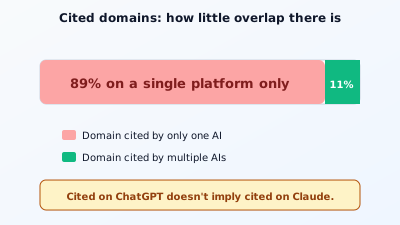
The reason is mundane and inconvenient. The four major AI search tools query different indexes. They run different crawlers. They have different training data. And they have different preferences for sources. Only about eleven percent of the domains cited in AI answers appear across more than one platform. The other 89 percent are platform-specific one-offs.
In this post, we look at who uses what, why the results diverge so much, and what you can do in practice without quadrupling your content pipeline.
Who queries which index?
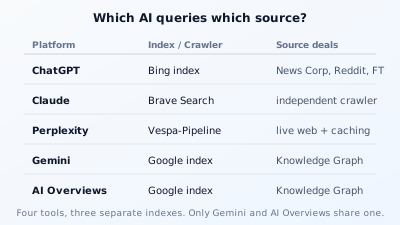
The single most important insight for the next twelve months is one that the SEO industry rarely states out loud. AI search tools are not search engines. They are language models that query a real search engine in the background, summarize its results, and present them with source citations. Which search engine runs in the background is what decides who gets cited at the end.
ChatGPT. OpenAI uses the Bing index for web search in ChatGPT. When someone asks a question that requires fresh web content, a Bing search runs in the background and the model summarizes the top results. In addition, OpenAI has bilateral content deals with large publishers: News Corp (Wall Street Journal), Reddit, Financial Times. That content either feeds into training or directly into answers. If you rank poorly on Bing and don't happen to be inside one of those partner databases, you have a structural visibility problem in ChatGPT.
Claude. Anthropic's assistant uses Brave Search for web queries. Brave runs its own crawler and its own index, intentionally built independent of Google and Bing. That is a notable choice. Brave indexes far fewer pages than Google but with its own quality heuristics. If you are not found in Brave, you are invisible in Claude. If you rank well in Brave, you can be cited even when you sit on page two of Google.
Perplexity. Here it gets unusual. Perplexity does not plug into an external search engine. They built their own pipeline on top of the open-source Vespa platform. They crawl themselves, index themselves, and combine that with live web calls for fresh content. Their logic favors structured, citable content with clear statements, because every answer links multiple sources. Anything that reads like a research brief has an edge. Anything that reads like advertising copy does not.
Google Gemini and AI Overviews. Both use the Google index plus the Knowledge Graph. This is the only one of the four AI search products where classic SEO translates more or less directly. That was the point of our post on Google's AI SEO documentation. From Google's perspective, there is no reason for a separate discipline. From your perspective, Gemini is only one of four AI search products that matter.
The consequence fits in one sentence. Anyone in 2026 who treats classic Google search and AI Overviews as "the AI search" is optimizing for maybe half of AI-driven traffic. The other half runs through indexes that no one reaches without deliberately working on them.
Why the answers diverge so widely
Essentially four factors drive the fact that the same question in four AI tools can produce four partly different answers with partly completely different sources.
Different training data. OpenAI has deals with News Corp, Reddit, and the Financial Times. Anthropic, by its own account, has not signed comparable publisher deals. Google has built the world's largest web index over 25 years. Perplexity works primarily with the public crawled web plus academic and Wikipedia sources. The very foundation each model was trained on looks different.
Isolated crawler infrastructures. GPTBot, ClaudeBot, PerplexityBot, and Googlebot are four different bots with four different user agents and four different crawl strategies. Each bot visits different pages at different frequency. If your robots.txt blocks one of them, you are missing there. If your hosting gives one of them flaky responses, you are missing there. There is no shared crawler feeding all AI answers.
Different retrieval systems. Bing ranks differently from Brave, and Brave ranks differently from Perplexity's own pipeline. That means the same page can be position 3 on Bing, position 17 on Brave, and not in Perplexity's index at all. Anyone who only watches Google never sees two-thirds of it.
Individual alignment processes. Even if two models read exactly the same sources, they write different answers. Anthropic, OpenAI, and Google train their models with different human-feedback procedures. That influences which sources end up passing as "citation-worthy" and which fall through the evaluation filters.
In sum: Four independent systems. Four different selection mechanisms. And four different answers at the end with only a small shared intersection.
The 11-percent number and what it really means
The most-quoted figure in the current GEO discussion comes from an analysis of AI answers across multiple platforms: roughly eleven percent of cited domains appear on more than one AI platform. The other 89 percent are platform-specific one-offs.
That sounds trivial at first but has practical consequences that many SEO teams underestimate. If you are visible in ChatGPT for a keyword, it tells you almost nothing about whether you are visible in Claude. If your biggest competitor dominates on Perplexity, you cannot infer that from Google rankings. Classic rank tracking, which only measures one search engine, blanks out three of the four AI worlds.
The other consequence is more optimistic. If the worlds diverge that far, then there are niches in the smaller AI search worlds where you can become visible today with less competition. Anyone well-indexed in Brave can show up in Claude for topics where they sit behind twenty market leaders in Google. Anyone who manages to land inside Perplexity's view of the "citable source" with well-structured, fact-rich content has an edge there that is not necessarily reproducible on Google.
That is the flip side of fragmentation. It is more work. But it also opens spaces where smaller providers can catch up, ones that no longer come anywhere near the top in classic Google search.
Try it yourself: Before you worry about AI platforms, run your page through the classic on-page fields in the SEO check. A clean title, description, canonical, and JSON-LD are the foundation that lets any of the four AI tools read your page at all. In under 30 seconds you'll know whether your page is indexable enough to show up in any AI world.
What you can do without quadrupling your pipeline
Honest answer first: completely serving the four AI search tools separately is nonsense for most websites. You don't need four content strategies. You need one that deliberately serves all four crawlers, plus three small per-platform levers. Here are the levers, sorted by effort-to-benefit ratio.
Take Bing seriously. The single most underestimated lever for ChatGPT visibility is clean Bing indexation. Bing ranks differently from Google, has a smaller index, and a weaker spam filter. That means: pages that sink into mid-position obscurity on Google often sit far higher on Bing. What you can do: submit your sitemap to Bing Webmaster Tools, check indexation there, and use IndexNow so new content reaches the Bing index faster. IndexNow is an open protocol that Bing and Yandex support. Plugging it in automatically speeds up ChatGPT visibility too.
Allow the Brave crawler and watch it. Brave Search is small but important because it feeds Claude. The crawler is called Bravebot and should not be blocked in your robots.txt. There's no dedicated XML-sitemap submission for Brave, but Brave follows classic backlink signals and reads your standard sitemap when it's referenced in robots.txt. Anyone linked from Wikipedia or established domains almost automatically shows up in Brave. Anyone not in that situation has a harder time there.
Allow PerplexityBot and have fact-rich pages. Perplexity crawls with PerplexityBot. That one belongs out of the block list too. Content-wise, Perplexity prefers pages that make claims in clear sentences that a language model can quote. Long my-day-at-the-office stories aren't worth much there. Short, precise statements with a date, a number, or a concrete example come first. Anyone who already writes good guide content barely has to change anything. Anyone whose prose meanders should take a ruler to it.
Keep maintaining structured data. Even though Google said in its own documentation that structured data is not required for AI Overviews: Perplexity evaluates it. Bing evaluates it. Schema markup with clear author, date, and article information helps your page appear as a source in AI answers. Anyone publishing a post without datePublished and without author makes it harder for any model to classify it as serious.
Build platform-specific rank tracking. If you actually want to know where you stand, you have to measure each AI world separately. Classic rank trackers only show Google. For ChatGPT, Claude, and Perplexity, there are dedicated logging methods where you formulate typical customer questions, capture the answers, and check which domains get cited. That is manual work. But it's the only method that really shows who is in front per platform.
What you specifically do not need to do
At least as important as the list of levers is the list of non-levers. Here, too, the industry has sold a lot in the last twelve months that doesn't move much.
You do not need to write a separate content version for every platform. That would not only be expensive, it actually violates Google's spam guideline on what they call Scaled Content Abuse. One good page that all four crawlers read beats four mediocre pages that each only one reads.
You do not need to create a dedicated file for every AI bot. The much-discussed llms.txt is a recommendation that has not yet established itself in the crawl heuristics of the big vendors. Whoever sets one up as a 50-line file has a small bonus if it becomes relevant. Whoever leaves it out loses almost nothing today.
You do not need to buy mentions in third-party text in the hope of appearing in AI answers. All four major AI vendors have spam filters that detect exactly that kind of coordinated mention. What gets weighted there are sources a human would independently cite because they have substance.
You do not need to chop every post into tiny bites in the hope that "content chunking" is somehow better for AI. The models understand the context of a longer page. Anyone who chops a 2000-word post into ten 200-word snippets loses more reading flow than they gain in AI bonus.
How we cover this in yourseo
We do not build yourseo as a "GEO tool" and we are not going to. For two reasons.
First, because Google has clearly said for its own AI world that it isn't needed. We wrote about that here last week in full detail. Anyone optimizing properly for Google is properly positioned in AI Overviews and Gemini.
Second, because a generic "AI visibility module" for the other platforms would be more marketing than substance. What really helps cannot be condensed into one AI score. Bing indexation, Brave crawl, fact-rich pages, structured data. Those are concrete, separately checkable disciplines. We build them into the regular audit without slapping a "GEO" sticker on them.
Concretely that means: the yourseo audit checks whether your sitemap is submittable to Bing, whether GPTBot, ClaudeBot, and PerplexityBot are not accidentally listed in your robots.txt, and whether your schema data is complete enough that each of the four AI worlds can categorize you as a source. Anyone with the basics in order is prepared for 80 percent of AI visibility. The last 20 percent is platform-specific detail work that a tool cannot do for you, because it consists of content and reputation.
Our take: think once, then act pragmatically
If you put all of this together, you land at a position that is neither "GEO is everything" nor "GEO is nothing". It sits in between, and that is also the position we recommend to clients.
Classic SEO remains the largest lever. Not because Google says so, but because indexable, technically clean, substantively meaningful pages do better in each of the four AI worlds than the opposite. Anyone doing their homework here has the basis for everything that follows.
Bing SEO is the largest underestimated lever. Anyone who wants to start one concrete new initiative in the next twelve months should populate Bing properly. That opens the door to ChatGPT without needing a separate pipeline.
Brave and Perplexity come along for the ride if you don't lock the crawlers out and write with substance. For 90 percent of websites, more is not needed. A strong domain shows up there almost automatically. A small domain can use these smaller worlds as a cheaper entry point precisely because there is less competition.
A separate content strategy per platform is overkill for everyone except the very largest news publishers. Anyone with more than one full-time SEO on the team can try it. Anyone running solo or as a small agency should concentrate on the classic lever and on Bing. The rest follows.
And if the whole debate makes you nervous: this is not a technical question, it's a market question. Twenty years ago Google was not the only search engine. There was Yahoo, Altavista, Lycos. SEO was a multi-front business back then too, before Google pushed everyone else aside. We are about to live through the same story again. This time with language models instead of search engines, and with the same open question of who dominates in the end. Until that is settled, it pays off to be present in more than one world, without quadrupling your presence. That is the sober answer to a very excited debate.
If you want to take it a step further and have your own page checked end to end without anyone pasting an AI buzzword onto it, yourseo.app is the sober standard. Classic audit, classic rank tracking, classic local SEO. The basics that any of the four AI worlds presupposes, plus the crawler checks for the three additional bots no one else takes seriously. Doing that gives you no GEO strategy. But it gives you a better position than 90 percent of competitors still arguing about the word.
The source and starting point for this post was SEO Südwest's analysis on the platform specificity of GEO. Anyone wanting to read further will find the original quotes there on training-data deals and the 11 percent number.