In mid-May 2026, Google published an official documentation that surprised a large part of the AI SEO industry. The core message: if you're well-optimized for classic Google Search, you're well-optimized for AI Overviews and the new AI Mode. From Google's perspective, a separate discipline called "AI SEO" or "GEO" does not exist.
For anyone who has spent months worrying about whether to switch to llms.txt files, AI-specific markup, or content chunking: you don't have to. What you need, you probably already have. Solid classic SEO. And if you don't, there are far more concrete levers than AI theory.
In this post, we summarize what Google actually said, what the five most common myths were, and what changes for yourseo users from our perspective. Plus the sober answer to the question of whether you should delete the llms.txt file you created yesterday.
What Google officially said
The new docs are explicitly aimed at site owners who want to remain visible in AI Overviews and AI Mode. The central sentence reads, in paraphrase: "Optimizing for generative AI search means optimizing for search, and therefore it's still SEO."
With that, Google positions itself against a growing market of consultants, tools, and courses that sell special services under terms like GEO (Generative Engine Optimization), AEO (Answer Engine Optimization), or simply "AI SEO". From Google's perspective: there is no separate optimization for AI search. There is only one optimization, and it's called SEO.
That's a strong statement because it has two effects. It reassures everyone who already knows the classic craft. And it removes a large part of the sales basis from tool vendors offering special "AI Visibility Scores" or "GEO audits". What's notable is the sharpness of the wording. Until recently, Google said: "AI search benefits from good SEO." Now it says: "There is no other optimization."
How AI search actually ranks
To prevent this from being just a marketing statement, Google's docs describe in concrete terms how AI answers are produced. Two techniques are at play, and both build directly on the classic search index.
Retrieval-Augmented Generation, or RAG. Google also calls this "grounding". The language model that generates the answer doesn't invent the information. It queries the classic Google index for relevant, recent pages on the user's question, reads them, and assembles a short answer with clickable source links. If you don't rank in the classic index, you don't make it into the grounding step in the first place. For more on the underlying logic, the Wikipedia page on Retrieval-Augmented Generation explains the method without marketing spin.
Query fan-out. For more complex questions, Google generates related searches in parallel. The example from the docs: someone searching for "how do I fix a lawn full of weeds" automatically triggers additional searches like "best herbicides for lawns" or "removing weeds without chemicals" in the background. These expanded queries run through the same ranking systems Google has used for years.
The consequence can be summarized in one sentence: AI search has no separate ranking world. It consumes the existing one.
GEO and AEO: Google calls it plain SEO
Two acronyms have been circulating in the industry since early 2024, sold as new disciplines. GEO stands for Generative Engine Optimization, meaning optimization for generative AI search. AEO stands for Answer Engine Optimization, meaning optimization to be cited in AI answers.
In the docs, Google explicitly states that, from its point of view, neither term is a separate discipline. It's SEO. Period.
If you just spent money on a "GEO audit" that mainly sold you llms.txt templates and content chunking, this is a good moment to review the invoice. If the budget hasn't been spent yet, keep it and invest in the content. That's where it lands most usefully anyway, according to Google.
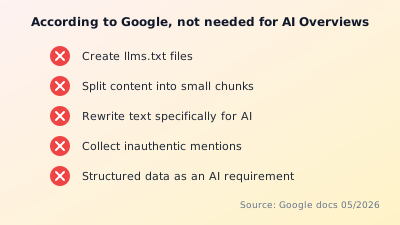
Five measures Google says you don't need
In a dedicated "myth-busting" section, Google addresses commonly recommended optimizations and says: not needed. Here are the five points, paraphrased from the docs.
1. llms.txt files and special AI markup. You don't need to create any new machine-readable files, dedicated AI text files, or extra Markdown to appear in AI Overviews. Google reads the same HTML pages it has been reading for twenty years.
2. Content chunking. Splitting long texts into the smallest possible chunks is, according to Google, unnecessary. The systems can understand the nuances of multiple topics on a single page and surface the relevant section. There is no ideal page length. So if you're currently slicing all your 2000-word articles into ten 200-word snippets, you can undo it.
3. Rewriting content specifically for AI. You don't need to rewrite your texts for AI consumption. The model understands synonyms and general meanings, so not every long-tail variant has to appear separately. "Remove lawn weeds" and "lawn weed control" land in the same understanding bucket. You don't need a separate page for each.
4. Chasing inauthentic mentions on other sites. Trying to appear in the AI answer through coordinated mentions in other texts brings little. Google's ranking systems favor high-quality content, and spam systems block the opposite. The AI features depend on both. That largely removes the usual "brand mention seeding" from the playing field of AI optimization.
5. Structured data as an AI requirement. Structured data remains useful for rich results, meaning stars, FAQ accordions, sitelinks, breadcrumb trails. It is not, however, required for AI Overviews. If you add FAQ schema, you're optimizing for the classic snippet game, not for AI. That doesn't mean: drop schema. It means: don't expect an AI bonus for it.
That's a pretty short, pretty clear list. And it cleans up a lot of industry folklore that has been sold over the past 18 months.
Check classic SEO first, then AI: before worrying about AI Overviews, run through the eleven on-page fields Google has ranked for the past ten years. The free SEO check at yourseo.app/analyse verifies title, description, canonicals, snippet length, hreflang, and JSON-LD in under 30 seconds. If you're green there, you're also set up for AI Overviews. If not, you have a higher lever there than in any AI optimization.
Commodity content vs. non-commodity content
If technical tricks don't decide AI search, what does? In the docs, Google explicitly introduces a term that gives the answer: commodity vs. non-commodity content.
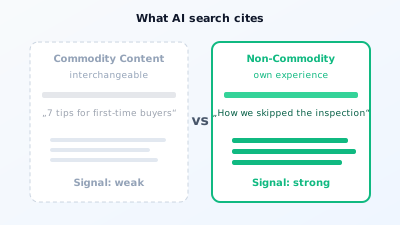
Commodity content is mass-produced material. The example from the docs: an article titled "7 tips for first-time home buyers". Such texts are based on general knowledge that exists a thousand times across the web and offer little that isn't available elsewhere. From an AI perspective, this is an interchangeable building block. If your page disappears, the AI takes another one. It makes no difference.
Non-commodity content has a recognizable point of view. Google's example: an article titled "Why we skipped the inspection and saved money: a look down the sewer line". Personal experience, concrete numbers, a thesis that a stock article wouldn't have. The AI likes to cite that kind of content because it doesn't have a replacement.
This is basically the same message Google has been pushing since the Helpful Content Update of 2022. But now it's explicitly transferred to the AI era. If you produce generic SEO texts that are interchangeable in content and tone, you're optimizing for a ranking that no longer exists in that form. If you tell your own stories, cite numbers, and take a position, you've won in both worlds.
What's notable is the second part of this passage. Google explicitly warns against creating separate content versions for every conceivable search variant. Doing so primarily to manipulate rankings violates the spam guideline on "Scaled Content Abuse". The AI systems understand relevance even without an exact keyword match. Translated: don't write ten nearly identical pages for ten long-tail variants of the same topic. Write one good page and trust the system to make the connection.
What Google says you actually should do
If you distill the docs down to what Google calls mandatory, a surprisingly short list remains.
- Be indexable. Your page must be able to land in the Google index. robots.txt must not block it, the page must not be noindex.
- Be eligible for snippets. If you're under
<meta name="robots" content="nosnippet">, you don't show up in AI Overviews. - Be crawlable. Generative models learn patterns from publicly accessible content. If Googlebot can't reach your page, the model doesn't learn it either.
Plus the classic quality signals Google has consistently named since the official SEO Starter Guide: title and description, clean HTML, fast load time, unambiguous canonicals, internal linking that forms topic clusters. For local businesses, Google adds: maintain a Google Business Profile, use Merchant Center for e-commerce, and the new "Business Agent" as a chat interface directly inside Google Search.
What's striking is what's not on the list. No llms.txt. No schema markup as a requirement. No special meta tags. What Google demands is essentially what Google demanded in 2015. Content that helps humans, and a technically clean site.
A note on that, because many people confuse this. Indexable doesn't mean "can be crawled by Google if someone links to it". Indexable means: your sitemap lists the page, your internal linking leads there, and the page doesn't serve noindex. If you already have issues with canonicals or sitemap conflicts in the classic audit, you can skip the AI debate until that's fixed. The classic on-page fields in an audit are the starting point, not the AI model.
Agentic future: what comes after AI Overviews
The docs end with an outlook that most reports have skipped. Google is preparing site owners for "agentic experiences". This refers to AI agents that autonomously perform tasks for users: making reservations, comparing product specifications, placing orders.
Such agents would analyze sites via browser agents. Google points to an emerging protocol called the Universal Commerce Protocol (UCP), intended to give search agents expanded capabilities, and recommends becoming familiar with "agent-friendly best practices".
In concrete terms, that probably means: forms that an agent can fill automatically. Product pages with clear prices, availability, and specifications. Clear call-to-action buttons that don't hide behind three cookie banners. A site that a human can operate in ten seconds can probably be operated by an agent in two seconds. A site with a modal stack, login wall, and unloaded JavaScript components is a problem for both.
Here, Google is in diplomat mode. It doesn't say outright that bad usability will soon also cost automated customers. But the hint is clear enough. Whoever knows where their conversion paths break today has a head start. Whoever doesn't look at all will have one more problem in three years.
Our take: what changes for yourseo users
If you read the docs, one question inevitably comes up. Should I delete the llms.txt file I just created? Should I stop adding FAQ schema or article schema? Should I no longer pad pages that have only 800 words, because Google said there's no ideal length?
Our take, honest and nuanced:
We still recommend llms.txt. Google's statement applies to Google. Other AI engines like Claude, ChatGPT with web search, or Perplexity have in some cases explicitly referenced llms.txt in their crawl heuristics over the past few months. How that develops over the next twelve months, nobody knows. Maintaining a 50-line file with effectively no effort covers that uncertainty for minimal cost. The yourseo audit still checks the file, but it's no longer a failure marker. It's a recommendation. Sites without llms.txt no longer lose score points. They get a note with a reference to Google's docs and our reasoning.
Schema markup remains important. Google said structured data is not required for AI Overviews. But it's still required for rich results in classic search, and rich results historically bring two to three percentage points more CTR. If you add FAQ schema, article schema, and BreadcrumbList, you're not optimizing for AI. You're optimizing for what Google has been showing in results for years with stars, FAQ accordions, and breadcrumb paths. That stays. Anyone who wants more on snippet optimization should read the title and meta description tuning post, which shows the mechanics in detail.
Content quality is the only thing that really matters. The commodity vs. non-commodity distinction is the most important statement in the docs. A post that says nothing twenty others don't also say has no anchor in the AI output. A post with its own experience, its own numbers, and a position does. That's the work nobody can delegate and no "GEO tool" can replace.
Indexability is non-negotiable. If your page is noindex, blocked, or only client-side assembled via JavaScript, you're out. From classic search and from AI Overviews at the same time. The first step before thinking about AI is always the same: run through an honest on-page tool to verify whether your pages are technically indexable and whether the on-page basics hold up.
Anyone who spent the last year designing some "AI Visibility Strategy" can now breathe a sigh of relief. Anyone who spent the last year writing usable content and keeping the technical foundation clean bet on the right horse. That's the shortest summary of the docs we can manage.
If you don't yet know exactly what yourseo actually does, here it is in one sentence: an all-in-one SEO suite with on-page check, rank tracking, audit, and a local SEO module, built for small and mid-sized websites in Germany. We don't sell a separate AI module, and we won't, as long as Google itself says one isn't needed.