Sistrix has been the benchmark in German-speaking SEO for over 15 years. Its visibility index is the industry standard, the toolkit is deep, support sits in Bonn. That comes at a price: 119 euros per month for the base module, and anyone wanting the full suite with links, ads, and content quickly lands beyond 400 euros. For an established agency that's bearable. For an SMB website or solo marketer it's rarely worth the value.
The good news: the German SEO tool market in 2026 is more mature than ever. There are at least five serious Sistrix alternatives with servers in Germany or the EU, GDPR-compliant, with German support and honest pricing. In this post I introduce them, sort them by use case, and make clear where Sistrix remains unbeatable and where an alternative is the better choice.
Why look for a Sistrix alternative at all?
Three reasons website operators today look for alternatives instead of jumping straight to Sistrix.
The price. 119 euros for the base module, plus 100-200 euros for backlinks, ads, content, social. Anyone wanting the full suite spends 400-600 euros per month. Over twelve months that's 4,800-7,200 euros. For a ten-page law firm site or a local craftsman, that's absurd.
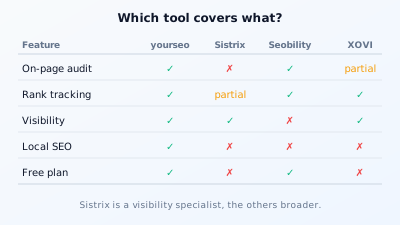
Missing on-page audits. Sistrix is a visibility specialist. A classic technical crawl of your own domain isn't part of the toolkit. Anyone wanting to find title tag issues, duplicate content, slow load times, or broken canonicals needs a second tool (Screaming Frog, Seobility) or an add-on. The total cost is usually higher than the pure Sistrix bill suggests.
No free plan. Sistrix has no free tier sufficient for an SMB site. Anyone wanting to test has a seven-day trial. After that, full price or nothing. Other tools have real free plans you can start with permanently.
Sistrix remains an excellent tool on its own. But the question isn't "is Sistrix good", it's "is Sistrix the right choice for my situation". For small and mid-sized websites the answer is almost always no.
What a serious Sistrix alternative must deliver
Before listing tools, the criteria list. An SEO tool from Germany aiming to compete with Sistrix must cover at least these five disciplines:
- Visibility index or comparable score for your domain, ideally with historical history
- Rank tracking for a sensible keyword count (at least 100, better 500+)
- Technical on-page audit with a full-domain crawl
- Keyword research with volume and competition
- GDPR-compliant hosting in the EU, clearly documented
Anyone blank in one of these disciplines isn't a serious alternative, just a specialty tool. That's not bad per se, but then you'd need a second tool and the math changes again.
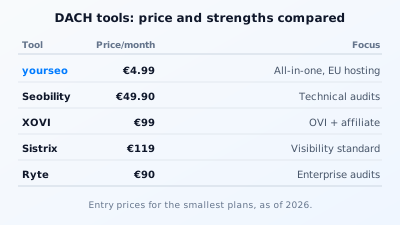
The five Sistrix alternatives that matter
yourseo
Short version: All-in-one suite from Germany, built for small and mid-sized websites. On-page audit, rank tracking, visibility index, local SEO, trust widgets in a single tool. Servers in Germany.
What it delivers: the SEO audit checks 35 lite and 14 paid-only on-page items per URL including title, meta, schema, Core Web Vitals, canonicals and JSON-LD. Rank tracking on real Google data via Search Console and our own crawler. Visibility index 0-100 with weekly trend. Local SEO module with geo grid and review tracking. Plus the differentiator: integrated Google review widgets for your own site, a feature Sistrix doesn't have.
Price: from 0 euros (free plan with real audit), Starter 4.99 euros, Pro 39 euros, Agency 199 euros. Free plan suffices for one domain with 20 keywords and one audit per week.
Strengths vs. Sistrix:
- On-page audit built in, no second tool needed
- 25x cheaper than the Sistrix base module
- Real free tier
- Trust widgets as a CRO lever
- Swiss-army-knife approach for SMBs
Weaknesses vs. Sistrix:
- No historical data treasure back to 2008
- Smaller keyword database
- Younger tool, fewer tutorials in the industry
When it makes sense: solopreneurs, SMBs, local businesses, agencies up to 17 sites. As soon as you have a double-digit number of sites and don't need to look back to 2008, yourseo is the most cost-effective alternative on the German market.
Seobility
Short version: Specialized in technical on-page audits and crawl. Made in Germany, hosting in Germany.
What it delivers: an excellent site crawler that finds duplicate content, internal linking gaps, broken redirects and status code problems. Solid keyword monitoring with competitor comparison. Clean reports you can hand to clients.
Price: entry 49.90 euros per month, free plan for one domain with limited features.
Strengths: best audit depth among DACH tools for the price. If the single goal is "be technically clean", Seobility is unbeatable.
Weaknesses: no proprietary visibility index, weak backlink analysis, no local SEO, no review widgets, no Search Console integration as a first-class citizen.
When it makes sense: web developers and technical SEOs wanting a second opinion next to Screaming Frog. Not suitable as an all-in-one.
XOVI
Short version: German all-in-one suite with keyword monitoring, on-page, backlinks and an affiliate module. OVI as its own visibility index.
What it delivers: the OVI (Online Value Index) is a usable alternative to the Sistrix index. XOVI additionally has an affiliate analysis module that surfaces competitor affiliate structures. A niche no other tool serves. German UI, German support.
Price: 99 euros per month.
Strengths: reasonable price-performance in the mid-tier. Affiliate analysis is unique.
Weaknesses: interface feels dated in places. Keyword database smaller than Semrush or Ahrefs. Audit crawl less thorough than Seobility. Updates and new features ship less often than at up-and-coming tools.
When it makes sense: agencies used to OVI tracking who want to analyze affiliate competitors. Anyone not needing that fares better with yourseo or Seobility.
Sistrix itself: when does it still make sense?
Yes, Sistrix remains the answer to a specific question: "I need historical visibility data back to 2008, and the Sistrix index is the KPI my board measures me by." If both sentences are true, Sistrix is irreplaceable. Nobody else has the data.
Sistrix' SERP analytics are also deep: you see not just positions, but featured snippets, ads, SERP features in detail. For agencies selling premium consulting reports, this depth is part of the business model.
For 90 percent of websites, both are irrelevant. Whoever is honest with themselves doesn't need Sistrix.
Ryte (enterprise special case)
Short version: German enterprise SEO tool with focus on large crawls and compliance reports. Hosting in Germany.
What it delivers: very large crawl volume (millions of URLs), deep technical audit, compliance reports for WCAG and GDPR. Integration into enterprise CMS landscapes.
Price: entry around 90 euros, enterprise plans in four-digit range.
Strengths: scalability. If your site has 100,000+ URLs, Ryte is one of two tools in the DACH market that can handle it.
Weaknesses: overkill below 1,000 URLs. Steep learning curve. Not the right choice for a 50-page SMB.
When it makes sense: online shops with 5,000+ products, large publishers, corporate websites.
Check yourself in three minutes: Before committing to a tool, run through the free SEO check at yourseo.app/seo-check. You'll see immediately which of the 35 on-page fields are fixable on your site. If you pass them green, you don't need a premium tool at all. You need rank tracking. If not, the on-page foundation is the lever with the best effort-to-benefit ratio, not a new tool.
Which tool for which use case?
The honest recommendation matrix.
Solopreneurs and freelancers (1 site, under 20 keywords). yourseo Free or Starter. Costs 0-4.99 euros per month, covers audit, rank tracking and visibility. If you work with a local angle, you also have the maps module included.
Small to mid-sized businesses (2-4 sites, 50-400 keywords). yourseo Pro at 39 euros per month. Plus optionally Seobility at 49.90 euros per month if the audit crawl needs to be extremely deep. Both together cost less than the Sistrix base module alone.
Local businesses with maps focus. yourseo with the Local SEO plugin. Competitors plainly don't have this. Sistrix doesn't serve local SEO, Seobility neither, XOVI only rudimentarily. Anyone wanting to be found in Google Maps has a clear choice here.
Agencies with 5-20 client sites. yourseo Agency at 199 euros per month. White label, API, 17 sites included. That's less than one Sistrix module. For agencies that need historical data, an additional single Sistrix account for spot checks can work alongside.
Corporations and enterprise. Ryte or Sistrix Enterprise. Here it's not price that matters but scale and compliance.
What to consider when switching
Three pitfalls.
Historical data is lost. Migrating away from Sistrix loses the long trend. What you can do: export your Sistrix index history as CSV and keep it in a spreadsheet for reference. You retain the old line and build the new index next to it.
Different tools use different keyword pools. If you're well visible in Sistrix for 50 keywords today, the new index can show 0 on day one because the new tool doesn't track those keywords. Solution: feed the top 50 keywords manually into the new tool in the first two weeks.
CTR models differ. Different tools compute with different click-through rates. Even with identical positions, the index can vary by 20 percent. That's methodology, not reality. Anyone wanting to understand this can calculate the visibility index themselves and compare with the tool values.
GDPR and server location: what really matters
Many tools advertise "GDPR-compliant", but the details differ. Three tiers.
Real EU servers. Hosting in an EU data center, no data flows to the US. yourseo, Seobility, XOVI and Ryte meet this. Sistrix as well.
EU hosting plus US sub-processors. Tool hosts in the EU but uses Cloudflare US, Google Analytics or a US CDN for assets. Strictly speaking, the data flow must be documented via Standard Contractual Clauses. Many DACH tools let this slip through in the fine print, which can be a stumbling block in a compliance review.
US hosting with GDPR promise. Semrush, Ahrefs and similar. Here the promise is rhetorical, the legal situation since the Schrems II ruling in 2020 and the EU-US Data Privacy Framework from 2023 is uncertain. Anyone taking GDPR seriously and processing sensitive customer data should be cautious here.
The pragmatic standard for a DACH SMB: a tool with EU hosting, documented sub-processors, and a data processing agreement (DPA) signed and filed. Anyone unable to provide this fails the first customer audit. The official documentation from Germany's Federal Data Protection Commissioner is the right starting point for the legal depth.
What makes Sistrix unique (and what doesn't)
To keep the comparison fair, the Sistrix highlight reel.
Historical depth since 2008. Nobody else has it. If your domain has existed for 15 years and you want to trace when a core update hit it, you need Sistrix.
SERP feature detection. Sistrix shows not only positions 1-10 but also whether a featured snippet, a People Also Ask box, a knowledge panel or ads are displayed. That's detail level other tools partly have, but Sistrix the deepest.
Proprietary industry studies. Sistrix publishes SERP studies regularly that are cited across the industry. That's content marketing built on the data. Nobody else in the DACH market does this consistently.
What Sistrix is NOT particularly good at: on-page audit, local SEO, trust widgets, content optimization, deep GSC integration. All of this Sistrix users must cover with second tools. That puts the 119-euro argument into perspective.
An honest closing observation
Anyone making an SEO tool decision in 2026 shouldn't make it out of tradition. Sistrix was the standard in 2015 because there was nothing comparable. Today there are alternatives that are the better choice for 80 percent of websites because they deliver all-in-one, are significantly cheaper, and are built with modern UX standards.
The right question isn't "can I replace Sistrix", it's "do I even need Sistrix". For SMBs, local businesses, solopreneurs and mid-sized agencies the answer is almost always no. For corporate SEO teams with historical KPIs, yes.
If you're unsure, start with the free yourseo check and decide afterwards. 30 seconds of effort, no account needed, and you immediately see what your domain technically needs. If the list is long, on-page optimization is the lever, not a new tool. If it's short, you need rank tracking and competitive analysis, and there the price decides. And there, Sistrix rarely wins.
More on the direct tool comparison is in the post about the best SEO tools in 2026, which lines up all relevant providers with their features and prices side by side.