Anyone who spends a few hours in SEO tools can't avoid the term visibility index. Sistrix calls it that, Ahrefs calls it Domain Rating, XOVI calls it OVI, Semrush talks about Authority Score. Every vendor sells its own number as the most important KPI in SEO. Behind the marketing names sits the same math everywhere. And you can calculate it yourself without paying 119 euros a month.
In this post, I explain how the Google visibility index is actually calculated, why tool numbers can diverge so much, and how to build your own honest score using Google Search Console and a spreadsheet.
What is the visibility index, really?
The visibility index is a model number. It does not say how many visitors you get. It says how present your domain is in Google results for a defined keyword set. The higher the number, the more potential clicks you could theoretically capture if the average user clicks normally.
The logic is the same in every tool. Three inputs:
- Position of your domain for each keyword (1 to 100, or "not ranking")
- Search volume for each keyword (how often it is searched per month)
- Expected click-through rate for that position (CTR curve)
These three numbers are multiplied per keyword, all results summed, and the total normalized against a maximum. Out comes a number that many tools scale to the range 0 to 100, others to an index like 0.12 or 5.8. That's just scaling. The underlying information is identical.
The formula no SEO tool likes to spell out
Conceptually:
Visibility = Σ (Search Volume × CTR(Position)) / Σ (Search Volume × CTR(1))
In the numerator: for each keyword, multiply search volume by the click-through rate at your position. Sum over all keywords. In the denominator: the same sum, but as if you held position 1 for every keyword (maximum possible clicks). The ratio is your visibility.
Example with two keywords:
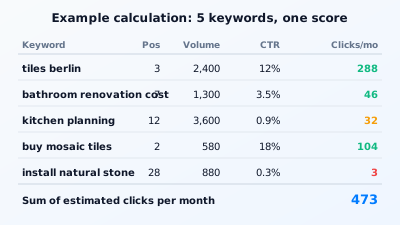
- "tiles berlin": volume 2,400, you're at position 3, CTR(3) ≈ 10 % → 240 expected clicks
- "bathroom renovation cost": volume 1,300, position 7, CTR(7) ≈ 3.5 % → 46 expected clicks
- Sum: 286 expected clicks
- Maximum (all at position 1): 2,400 × 28 % + 1,300 × 28 % = 1,036 clicks
- Visibility: 286 / 1,036 = 0.276 or scaled 27.6 / 100
That's the math. No magic to it. Anyone wanting to demystify the concept can start here. The Wikipedia page on Search Engine Optimization explains the concept from a scientific angle without marketing spin.
Why tool values still diverge
If the formula is the same everywhere, why does Sistrix show 0.18 and Ahrefs 4.2 for the same domain? Three reasons.
Different keyword pools. Sistrix tracks roughly one million German keywords. Semrush more, Ahrefs too. XOVI fewer. If you're a German trades domain ranking for 200 long-tail phrases that Sistrix doesn't have in its set, you're invisible there. In another tool that knows those long tails, your visibility looks much better.
Different CTR curves. Some tools use the famous Sistrix CTR table from 2014. Others have updated values from Search Console aggregates. Still others model with theoretical assumptions. Position 1 ranges between 25 and 35 percent CTR, position 10 between 1.5 and 4 percent. These differences compound across thousands of keywords.
Different search-volume data. Google itself only gives volume in broad ranges (via the Keyword Planner). Every tool builds its own estimates with its own models and clickstream data. For "tiles berlin" Sistrix may report 1,900, Ahrefs 2,400, XOVI 1,500. Three different values for the same real search.
In sum: three tools, the same formula, three different numbers. All correlate roughly with the truth, but none is "correct". Anyone comparing Sistrix index 0.18 to Ahrefs Domain Rating 32 is comparing apples to oranges. What matters is the change within the same tool over time.
The CTR curve in detail
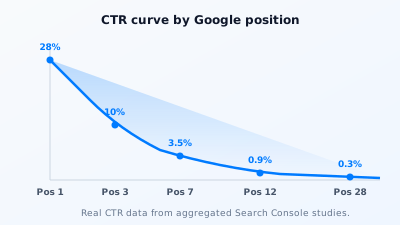
Click-through rate is the component that nearly every SEO tool keeps proprietary. Here's an approximation derived from aggregated Search Console studies that works for most industries in the DACH market:
| Position | Realistic CTR |
|---|---|
| 1 | 25 - 35 % |
| 2 | 15 - 20 % |
| 3 | 10 - 14 % |
| 4 - 5 | 5 - 8 % |
| 6 - 10 | 2 - 5 % |
| 11 - 20 | 1 - 2 % |
| 21+ | below 1 % |
The numbers swing widely by industry and SERP type. A pure information query like "what is seo" has higher CTRs at position 1 because there are no ads. A commercial query like "office chair buy" has lower organic CTRs because Google Shopping ads and sponsored listings dominate the first screen.
For your homework, the column above works as an estimate. If you want it more precise, pull historical CTR per position for your top queries from your own Search Console and use those individual values.
Measure your own visibility: You can have the whole exercise automated. The free visibility index at yourseo.app/visibility measures your real Google position for 3 to 5 keywords, pulls the search volume from live SERP data, and delivers the finished number plus an estimate of your monthly traffic. One domain per year, free.
In 30 minutes to your own visibility index
To do it manually, you only need three tools: Google Search Console, a spreadsheet, and about half an hour. Step by step.
Step 1: Define your keyword set. Which 10 to 30 keywords describe your business? Those are the searches that actually generate revenue. Not "SEO", but "SEO agency cologne" or "ergonomic office chair budget". Long-tail with buying intent counts more than generic mass keywords.
Step 2: Pull current positions from Search Console. In the GSC performance report you can see the average position per query for the last 28 days. Anything not ranking gets a 0 or "not in index" for the math.
Step 3: Estimate search volume. Google Keyword Planner gives rough ranges for free. More accurate is the search volume from the yourseo audit, which pulls live SERP data. If you don't have a budget here: use the middle of the Keyword Planner range.
Step 4: Apply CTR per position. Use the table above. Position 1 = 30 %, position 3 = 12 %, position 7 = 3.5 %, anything from 21 = 0.5 %.
Step 5: Calculate "expected clicks" column. Volume × CTR / 100. For "tiles berlin": 2,400 × 12 / 100 = 288.
Step 6: Calculate "maximum clicks" column. Volume × 30 / 100. For "tiles berlin": 2,400 × 0.3 = 720.
Step 7: Sum and divide. Expected clicks divided by maximum clicks equals your visibility index. Times 100 for a clean number.
Example final result: 1,870 expected clicks / 6,300 maximum clicks = 0.297. Visibility index 29.7 / 100.
What your own score tells you
A self-calculated visibility is more honest than any tool value because it only weights the keywords that actually mean revenue to you. You see:
Which keywords really carry the score. A single keyword with 5,000 volume at position 2 beats 30 long tails at 80 volume on position 8. Sorting by "expected clicks" shows you exactly where your SEO value comes from.
Where the cheapest lever sits. A keyword at position 8 with 1,000 volume currently brings about 30 clicks at CTR ~3 %. At position 4 with CTR ~7 % it would bring 70. Twice the traffic without new content, just by climbing 4 positions. That's the kind of math missing from most SEO reports.
Where you waste time. Keywords at position 28 with 200 volume bring less than one click per month at a realistic 0.3 % CTR. Anyone tuning there is optimizing for homeopathic effects. Only on page 1 does it count again.
The strategic conclusion: invest in content that lifts a keyword from position 8 to position 3, not in ten new long-tail pages that end up somewhere between 30 and 50. The visibility index as a self-calculation makes that leverage visible.
What Sistrix does differently
The Sistrix visibility index has established itself as the standard in the DACH market because it has been measured with the same methodology since 2008. That's its biggest value: historical comparability. If your domain showed 0.42 at Sistrix in 2018 and 0.28 today, you've structurally lost ground. That's a reliable signal nobody can reconstruct on their own.
The price is steep. Sistrix costs 119 euros a month for the base module. All other data (backlinks, ads, content) is extra. Anyone who only wants the visibility index pays 1,428 euros a year for a single number.
For small and mid-sized websites that's rarely justified. The better play: calculate your own index with the formula above, plus a cheaper weekly tool measurement or the yourseo visibility check, and one external validation per year via a Sistrix trial account so you don't lose the historical line. That's all it takes.
When the visibility index is misleading
Four situations where the number deceives.
Brand searches distort heavily. Ranking for your own brand name pulls the score up without it being real SEO. Sistrix filters brand searches partly out, other tools don't. If 30 percent of your index comes from "mycompany.com", you have brand recognition, not SEO value.
Branded search volume swings with the season. If your company was mentioned in a magazine in Q4, brand searches spike for three weeks. Your index rises without you having done anything SEO-related. After three weeks it falls back. Both are noise, not signal.
New tool updates to the keyword universe shift numbers. If your tool suddenly adds 50,000 new long-tail keywords with volume that you don't rank for anywhere, your index drops by 5-10 percent instantly. That's a methodology change, not a traffic loss. Always check if the tool had an update before discussing the index.
Core updates shift CTRs. When Google ships AI Overviews, organic CTR on position 1 may drop from 28 to 18 percent. Tools using old CTR tables compute too high. Anyone wanting a current index should use CTR values from 2024 or newer, not 2014.
What else you should measure
The visibility index is a trend indicator, not the end result. Anyone wanting to truly understand whether their SEO is working also looks at three hard numbers from reality.
Clicks from Search Console. The actual clicks Google sends to your URLs. The only non-modeled number, and it counts. Reading Search Console is the required reading.
Conversion rate from your analytics. Clicks without conversions bring no revenue. What you really want to measure is visibility × CTR × conversion rate × order value.
Rankings for your top 10 keywords. A granular view. The visibility index is the aggregate; individual keyword positions are the cockpit. The two complement each other.
If you run these three metrics alongside your self-calculated index, you have a complete picture. Tool visibility, own visibility, real traffic, real revenue. Any small or mid-sized website doesn't need more data to steer SEO honestly. Four numbers, collected in a spreadsheet, checked once a month, beat any dashboard with twenty charts that ultimately doesn't enable a decision.
How often should you recompute your index?
A pragmatic frequency for the self-calculation. Monthly is enough for most SMB sites. Anyone computing more often mostly sees noise. SEO effects typically need four to eight weeks to manifest in positions, and Google rotates top results weekly along internal update cycles.
Twice per quarter is enough to see the trend without drowning in daily volatility. Directly after a core update (typically three to five per year), a special calculation is worth doing to see if the domain gained or lost structural ground. That's six to eight calculations per year total, plus tool comparison. No more is needed.
An alternative for local SEO focus
For local businesses with a pure maps focus, the classic visibility index is not ideal. What counts here is not the position for a keyword across all of Germany, but how high you appear in the local map pack for the relevant search terms, measured at various geographic points across your city.
This geo-grid measurement runs differently. Instead of averaging one position per keyword, you measure 25 or 49 points in a 5×5 or 7×7 grid around your location. From the positions per grid point, a heatmap score emerges that shows you which districts you're well visible in and where you fail in maps. That's the actual local visibility index, and it has little to do with the classic Sistrix value.
Anyone needing both should keep the disciplines cleanly separated: classic visibility index for organic Google rankings, geo grid for maps visibility. Mixing them leads to muddled reports and false conclusions.
Summary in one paragraph
The Google visibility index is a model number made of position × search volume × CTR, normalized against maximum clicks. Every tool uses the same formula with different inputs, making the values incomparable between vendors. Anyone wanting to save money calculates their own index in a spreadsheet, with Search Console positions and a CTR table. The most important insight from this calculation is not the final number, but which keywords carry it. Whoever sorts and invests here turns SEO into a steerable system instead of an observation discipline.