"SEO app from Germany". Sounds like words that mean little, since software comes from anywhere and runs everywhere today. But anyone running an SEO app for a German website, a German online shop or a German consultancy quickly hits points where the country of origin actually matters. GDPR. Hosting. Invoice. Support language. Training material. Understanding of how Google works in Germany. This post breaks the label down, shows what counts, and is honest about where "from Germany" is marketing fluff and where it's a real difference.
What an "SEO app" actually is
Before sticking "Germany" in front, worth clarifying "SEO app". It's a catch-all for software that lets you actually carry out search engine optimization. The range runs from a browser plugin showing an on-page score per URL, all the way to a full suite with audits, rank tracker, keyword research, backlink analysis, competitor monitoring and reporting in one interface.
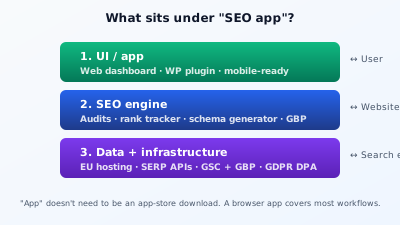
Under the hood every SEO app has three layers:
Layer 1, the UI. What you see as a user. A web dashboard in the browser, sometimes a WordPress plugin alongside or a native iOS/Android app. "App" doesn't have to mean app-store download. A browser-based web app is the better solution for 90 percent of SEO workflows because it runs on any device and needs no install.
Layer 2, the SEO engine. The actual work happens here. Crawlers analyzing your site, rank trackers querying positions, schema generators, GBP connections, backlink crawlers, keyword analysis. This is the value of a tool.
Layer 3, data and infrastructure. SERP data comes from paid APIs. The app itself runs on a server somewhere. Databases hold your audits, keywords and competitor observations. This is where it gets interesting if you run a German site, because GDPR kicks in here.
Anyone picking an SEO app checks all three layers. The UI is the obvious one, but rarely the decisive one. A polished surface on a weak engine delivers nothing. A strong engine on troublesome infrastructure is a compliance risk.
Why "from Germany" counts for European businesses
Five concrete points exist where the origin of an SEO app actually matters. They have nothing to do with patriotism and everything to do with legal consequences, hosting and practice.
One, GDPR and data processing. The moment you use an SEO app, you pass data to it: the URLs of your site, the keywords of your clients, sometimes login data for Search Console and Google Business Profile. All of that is processing on your behalf under GDPR. You need a data processing agreement (DPA) under Article 28. An app from Germany (or at least the EU) often supplies the DPA as a standard clause; a US app demands a standard contract plus appendices plus additional guarantees for data transfer to a third country. Possible in practice, but considerably more cumbersome.
Two, hosting in the EU. Where the servers stand on which your SEO data gets processed isn't irrelevant. Third-country transfers (for example to the USA) have become more problematic since Schrems II. An app running its servers in Germany, Austria, Switzerland or at least within the EU spares you the discussion with your own data protection officer or your client's.
Three, EU invoice and support. A VAT invoice with a German VAT ID. Support that responds in German in a language understandable to SMEs. A legal notice German courts would accept. Not SEO topics, but they make the difference day to day.
Four, German market context. Search behavior in Germany isn't the same as in the USA. Bing has a different market share here, local SEO works via different directories (Yelp isn't relevant here, the phone book and local directories are), review sources are distributed across Google, Trustpilot, ProvenExpert and similar platforms. An app that knows and integrates these German specifics saves you the painful translation of a US solution.
Five, compliance on downstream topics. If your SEO app provides a review integration for Google Reviews, it has to work in Germany (no questionable auto-reply bots, no review filtering). If it offers WordPress integration, the plugin should comply with WordPress.org requirements.
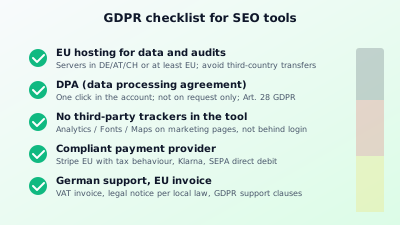
Together these five points decide whether "from Germany" on an SEO app is an empty label or practical value.
What a German SEO app technically has to deliver
An SEO app is only an SEO app if it covers the core work steps. The following functions belong in the German context:
On-page audit for German websites. The audit algorithm needs to handle German specifics: umlauts in URLs (münchen.de), ß spellings in title and headings, German Schema.org requirements (for legal obligations like the legal notice). A US app with an English audit schema misses references that count in Germany.
Rank tracker covering the DE language area. Position queries for German search terms on google.de, ideally with location differentiation (Munich vs. Hamburg vs. Berlin). More in the post on a free rank tracker for three keywords.
Local SEO with German directories. Google Business Profile is central, but location citations in Germany also run through Gelbe Seiten, the local phone book, industry-specific portals (Jameda for doctors, Anwalt.de for lawyers, MyHammer for tradespeople). A German SEO app knows these sources and offers NAP consistency checks for them.
Review integration with German platforms. Google Reviews as the main source, plus Trustpilot, ProvenExpert, KennstDuEinen, Jameda depending on industry. The app should read the most important of these sources and combine them for reputation reports.
Visibility index for German search terms. A dedicated score summarizing the visibility of your domain for a relevant German keyword set in one number. The visibility index has its quirks, but it's the most compact form to see your movement over time.
Reporting in German. Reports you forward to clients in readable German, not machine-translated English. Sounds obvious, but isn't with many international tools.
Try it yourself: The free SEO check at yourseo.app/analyse gives you a glimpse in under 30 seconds of how a German SEO engine concretely works. No signup, with DPA-ready data processing in the EU, with German interface.
Where "from Germany" doesn't help
Points exist where the country of origin brings nothing. Honest take here helps avoid wrong expectations.
SERP data comes from global sources. No matter where the SEO app originates, the raw SERP data (position of a keyword on google.de, search volume, click distribution) come from big international crawler indices. A "German SEO app" is just the processing layer here. There's no purely German SERP data provider with the data density of the international providers.
Backlink data is also global. Building an international backlink profile means relying on the big backlink indices, which are operated internationally. A German SEO app can license this data and process it in its interface, but the crawlers themselves aren't German.
Algorithm knowledge isn't nationalizable. How Google decides ranking is the same everywhere. A German agency can't know more than a US agency about what's behind the next core update. Claims like "we know the German algorithm" are empty on the merits.
What remains is the processing layer, the market context and the compliance level. That's exactly where the value of "from Germany" sits.
Which functions do you really need, which are gimmicks?
A German SEO app quickly has the reflex to offer "everything". In reality, most SMB sites only need a fraction of the features offered. What counts for a 30-to-150-page site:
Mandatory. On-page audit, rank tracker for the ten to 30 most important keywords, Search Console connection with prepared view, sitemap check, schema generator for the standard page types.
Very helpful. Google Business Profile integration with review monitoring, a lite competitor overview (two to three rivals), continuous visibility tracking as a weekly number.
Only for larger sites. Deep backlink analysis, competitor tracking across ten rivals, JavaScript rendering audits, log file analysis.
Gimmick for most. AI text generation as the main feature, AI visibility tracking (interesting, but usually premature for non-brands), automatic backlink outreach bots (often spam launchers).
Anyone picking an SEO app sorts the features into these four classes and checks whether the first two are completely covered. If yes, the tool match is good even if some gimmick features are missing. If no, the basis is missing no matter how pretty the gimmicks look.
Three practical examples where "from Germany" makes a difference
So this doesn't stay abstract, three everyday situations where the origin of an SEO app makes a concrete difference:
Example 1: Data protection officer reviews the contract. A tax firm with 50 employees rolls out SEO software. The external data protection officer reviews the DPA. With a US app the DPA runs twelve pages, includes standard contractual clauses, transfer impact assessments and references to Schrems-II requirements. With a German app on EU hosting, it's a two-page DPA along standard clauses of the BvD. The tax firm saves three weeks of clarification work.
Example 2: WordPress plugin in the official repository. A trade business in NRW wants to use the SEO app via a WordPress plugin. Plugins published in the official WordPress.org repository go through a code review. German vendors often have an understanding for EU-GDPR compliance that a US plugin vendor lacks. Example: a US plugin loads Google Fonts from the CDN, which is actionable under German case law. A German plugin vendor knows this and ships fonts locally.
Example 3: Training and support in German. An 8-person agency wants to build SEO tool knowledge across the team. A US app delivers webinars and documentation in English. Four of eight don't understand everything. A German app delivers training videos, documentation and support mails in German. All eight work effectively with the tool.
How to evaluate a German SEO app
Picking between two or three SEO apps works best with a checklist. The following ten questions cover the main decision aspects.
- Where do the servers stand on which my data is processed?
- Is the DPA per Article 28 GDPR offered without extra effort?
- Does the app deliver a German VAT invoice?
- Does support speak German?
- Are training material and documentation available in German?
- Is Google Business Profile integrated, and does the app know German review sources?
- Are the standard SEO functions (audit, rank tracker, schema, sitemap) present?
- How do prices compare to competitors, and are they transparent (no "custom pricing" without list)?
- Is there a free try-out path or a lite version?
- Who stands behind the company, is there a German managing director with legal notice?
At least eight of ten should answer Yes. Anyone landing at four or fewer has a more international solution in front of them despite "from Germany" in the marketing.
A valuable starting point for the legal requirements on data processing agreements is the BvD template DPA, which serves as an industry standard for many German data protection officers. It also helps assess a proposed DPA from an SEO app.
Where yourseo sits
Since this post sits in the yourseo blog, it should disclose honestly where the own tool stands. yourseo is an SEO suite developed and operated in Germany. The server stands in the EU, the DPA is standard, the invoice is German, support replies in German, training content is German, the WordPress plugin meets the requirements of WordPress.org. The WP plugin loads fonts locally, uses no external CDNs, respects GDPR requirements. The SEO engine covers audit, rank tracker, schema, sitemap, GBP, local SEO, visibility index and reviews.
What yourseo does not do: no proprietary backlink crawler infrastructure (that's licensed globally), no AI text generator as a main feature, no fully automated backlink outreach bots. Anyone looking for those is in the wrong place. Anyone looking for an SEO suite from Germany hosted, maintained and supported here is in the right one.
At a glance
"SEO app from Germany" is more than a marketing label when it comes to GDPR, hosting, DPA, German support and market context. It's a label when it comes to SERP data, backlink indices or algorithm knowledge (those are global). Picking a German SEO app means checking server location, DPA, invoice, support language, German directory integration and standard feature scope. Eight of ten checklist points should be in place. Then "from Germany" delivers a practical advantage. Otherwise it's just a word in front of the tool name.