Three terms come up in almost every conversation about search engine optimization, and three people often mean three different things by them. SEO analysis, SEO audit, on-page check. Anyone hiring an agency or shopping for a tool tends to leave the conversation more confused than they came in. There is a simple way to tell them apart: scope. How many pages are you looking at, how deep do you go per page, and do you pull in external data? Once you answer those three questions, the right term falls out automatically.
Three terms, three depths
Picture the three terms as nested circles. The on-page check is the smallest, the audit wraps around it, the analysis sits outside.
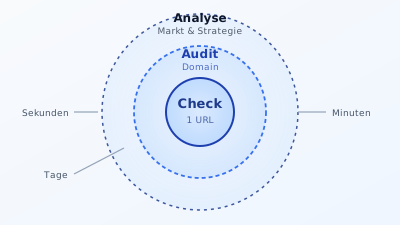
An on-page check looks at a single URL and inspects the visible levers. Title, meta description, H1, images, internal links on that one page. It's a snapshot, technically shallow, but quick. Within seconds you get a list of "missing", "too short", "duplicate".
An SEO audit is broader. A tool crawls the entire domain, compares hundreds or thousands of pages, checks server responses, redirects, duplicate content, status codes, and what Search Console says about indexing. The audit finds the problems no per-page check can ever see: hundreds of 404 errors in the internal link graph, identical titles across three language versions, canonical links pointing into the void.
An SEO analysis goes one layer deeper. It takes the audit and check data, combines it with keyword rankings, competitor data, backlink profile, search volume, and actual user behavior from Search Console and Analytics, and delivers a strategic answer. "Why aren't you ranking?" "Why have you been losing traffic since March?" "Which competitor is pulling ahead, and with what?"
| Term | Scope | Depth | Effort |
|---|---|---|---|
| On-page check | One URL | Technically shallow | Seconds |
| SEO audit | Entire domain | Crawl and technical | Minutes to hours |
| SEO analysis | Domain and market | Strategic | Days |
The order matters. Starting with the analysis before you have clean audit data builds on sand. Stopping at the check optimises a handful of pages and misses the structural problems of the domain. The three layers complement each other, they don't replace each other.
When the on-page check is enough, and when it isn't
If you're writing a new landing page, kicking off a blog series, or trying to get a stale page moving again, an on-page check carries you a long way. Within 60 seconds you know whether the title is set, whether the description makes sense, whether the H1 matches search intent, whether images have alt text. Roughly 80 percent of the on-page errors on an average website are so trivial that a check surfaces them all.
The check stops being enough the moment you want to know whether your entire domain is clean. A typical example: a small law firm in Munich, 14 subpages, one per practice area. Each individual on-page check reports green. Yet none of the pages rank well. Only the audit reveals that all 14 share the same meta description because the CMS template defaults that way, so Google treats them as near duplicates. The same pattern shows up in online shops when every category page carries the same boilerplate title. Per page it looks fine. Domain-wide it's a strategic hole.
There's an honest rule of thumb. Fewer than five pages and you rarely change anything? On-page check is enough. Thirty pages or more, or you publish new content regularly? You need a recurring audit on top. A hundred product pages and competitors in the same search space? Without periodic analysis you're flying blind.
What a good on-page check covers
To recognise a serious tool, here are the fields a good on-page check should cover:
- Title tag. Present, 30 to 65 characters, unique? Deeper background on the right length in our post on title tag and meta description optimisation.
- Meta description. Present, 50 to 160 characters, descriptive?
- H1. Exactly one, thematically aligned with the title?
- Heading hierarchy. H2 and H3 nested cleanly, no skipped levels?
- Mobile viewport. Meta tag with
width=device-widthset? - HTTPS. Clean SSL, no mixed content?
- Canonical. Set, valid URL, pointing at a reachable page?
- Image alt text. At least 80 percent of images labelled?
- HTML language.
langattribute in BCP-47 format, likeenoren-US? - Core Web Vitals. LCP under 1 second, TTFB under 200 milliseconds?
- Text volume. Enough substance per page, ideally 800+ words, at least 300?
That's eleven fields every single page should pass. Funny thing: more than half of small and mid-sized business websites fail to clear all eleven. Title and description, sure, but then alt text is missing, the canonical still points at the old URL after a domain change, or the same description shows up on 30 different pages.
Which of these eleven hurts most depends on the site. On an image-heavy portfolio site, alt text is critical. On a text-heavy blog, less so. On a shop with 800 products, a duplicate meta description across 200 product pages is poison. On a five-page consultancy site, it barely matters. A good check weights problems by severity and frequency instead of dumping an endless deficiency list with no priority.
Try it yourself: The free SEO check at yourseo.app/analyse inspects your page in under 30 seconds across all eleven on-page fields mentioned above. No signup, no plugin, with concrete hints instead of vanity score numbers.
Where the audit goes further
The audit pulls the data no per-page check can have access to:
- Crawl depth. How many clicks from the homepage to the deepest page? Anything beyond four is suspicious.
- 404 errors in the internal link graph. How many internal links point at pages that no longer exist?
- Redirect chains. Does a URL hop twice or three times instead of going straight to the target?
- Status codes. Does the server correctly return 404 for missing pages, or does it serve a 200 saying "this page doesn't exist"?
- Duplicate titles and descriptions. How often does the same title show up across different URLs?
- Structured data. Are Schema.org markups in place, and are they syntactically valid?
- Indexing status. How many pages does Google know about, how many is it choosing not to index, how many are blocked?
An audit of a 200-URL site routinely returns several hundred findings. That sounds like a lot, but it usually groups into five or six clusters you work through systematically. A good audit tool sorts the problems by severity and frequency so you don't drown in them.
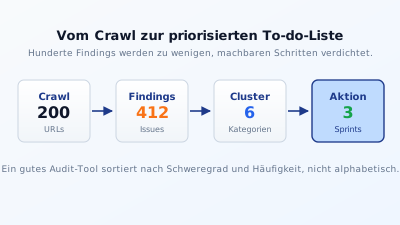
In practice the same pattern shows up again and again: 60 to 70 percent of all findings fall into two or three classes. Duplicate title tags, broken internal links, missing structured data. Anyone who clears those three classes in two weeks usually beats the person who spends months chasing edge cases. Audit findings are levers, not a homework list.
Where the analysis takes over
The audit finds the errors. The analysis answers the strategic question. Here's what an analysis does that an audit alone can't:
- It pulls keyword rankings for a few hundred or a few thousand defined queries over time, so you see trends instead of snapshots. The common visibility index abstracts these trends into a single number.
- It compares you against two to five competitors: which keywords are they ranking for that you aren't? Which content do they have that you're missing?
- It reads Search Console data for your own domain. Which queries bring impressions without clicks? Which pages sit at a high position but nobody clicks through?
- It looks at your backlink profile. Who links to you, who to the competition, where are the gaps?
- It connects the data into a prioritised action list. What moves the needle fastest with the least effort?
The analysis is not a one-click affair. Even when a tool delivers the data, someone has to interpret it. That's why most SEO analyses are either a consulting product or a tool-driven workflow where you make the calls yourself.
Three findings from real projects
So the concept doesn't stay abstract, three findings from actual audits:
Online shop, 1,400 products. The audit found 240 product pages without a meta description because the theme had auto-generation switched off. On top of that, 80 internal category links pointed at renamed URLs without redirects. Fix: three days of work, three weeks later a noticeable rise in Search Console impressions.
B2B service company, 35 pages. Technically clean at first glance. The analysis showed competitors publishing 2,000-word content for exactly the five main keywords, while this site's pages all clocked in under 400 words. On-page check green, analysis red. Fix: build content depth, not technical polish.
Local craftsman, 8 pages. Audit almost empty, everything ok. The analysis revealed a mismatch between the Google Business Profile and the imprint, plus no LocalBusiness schema on the site. A pure on-page check couldn't catch this, because the GBP entry lives outside the page. Fix: 30 minutes to embed the schema and align the address. Phone calls measurably went up afterwards. What that looks like in detail is covered in our post on local SEO in 2026.
How often, and who does it?
An on-page check belongs in your standard workflow for every new page. Before publishing, once again at the three-month mark as a routine, then on every significant change.
A full-domain audit is worth doing once a quarter for small sites, once a month for medium ones, and continuously for large shops with constant catalogue turnover. For a relaunch or domain change, it isn't optional, it's mandatory. Google's own SEO Starter Guide recommends documenting the baseline before any significant technical change. That's exactly what the audit is for.
An SEO analysis makes sense at strategic moments: a relaunch, a domain change, a sudden traffic drop, a new competitor in the market, or once a year as a deliberate stocktake. If you have someone in-house owning SEO, they can run it. Otherwise a specialised agency or a tool that prepares the data for you is the cleaner path, so you can spend your time on the decisions, not the data plumbing.
The three most common misconceptions
The same mental traps come up over and over. Three of them concretely hold sites back.
"We had an SEO check last year, that's enough." It isn't. A domain changes constantly. New pages appear, old ones get archived, the CMS gets updated, the hosting provider tweaks the server config and accidentally breaks a header. A check is a timestamp, not insurance.
"My tool says I'm at 92 out of 100." Score numbers are marketing, not diagnosis. Two tools can rate the same page at 92 and 67 because they weight differently. What matters is the concrete list of problems, not the aggregated number. Anyone who trusts the score optimises for the tool, not for Google.
"SEO is just technical." A technically immaculate site with no topical depth, no clear match to search intent, no organic linking won't rank. Technical setup is the ticket into the game. It isn't the game itself.
Quick FAQ
How long does an on-page check take? With a good tool, under 30 seconds per page. Done manually, about ten to 15 minutes if you genuinely check all eleven fields.
How much does a professional audit cost? For a 50-page domain, agency audits typically run between 800 and 2,500 euros. Self-service through a tool is significantly cheaper, but then you interpret the findings yourself.
Can a tool fully automate the analysis? The data gathering, yes. The "what does this mean for your market" judgement, no. Tools can make suggestions, but the call on priorities stays with you or with a consultant. Especially the question "which lever has the best effort-to-impact ratio in our industry" can only be answered with market knowledge, and that doesn't come out of a crawler.
Are tool score numbers useful at all? As a rough trend, yes. As an absolute rating, no. If your own score climbs from 78 to 84, that's a positive signal. If you compare your score from one tool against a competitor's score from a different tool, you're comparing apples to oranges.
Tool or agency? If you have someone in-house who broadly understands SEO and has the time: tool. If not, or if the domain is strategically important and attention is scarce: agency. Ideally both: the tool for continuous data, the agency for the sparring-partner role on big decisions. That setup also scales as the domain grows and the internal team gradually takes over ownership. You build a continuous data baseline through the tool while the agency helps you interpret findings.
At a glance
The check diagnoses a single page. The audit diagnoses the domain. The analysis builds the strategy. Running all three cleanly at the right cadence doesn't give you an edge over the market. It just means you've done the homework most others skip.